The Data Erasure Certificate: Your Essential Proof of Secure Data Disposal in the UK
For any organisation handling sensitive information, securely disposing of IT assets is not just an administrative task—it’s a critical compliance requirement. This proof comes in the form of a data erasure certificate.
Get Your Compliance DocumentationWhen retiring, repurposing, or recycling hardware, you need solid proof that data is gone for good. This guide explains what a data erasure certificate involves, why it is necessary for meeting UK regulatory standards like GDPR, and how professional services ensure your data disposal process is fully auditable and compliant.
Understanding Data Erasure Certificates
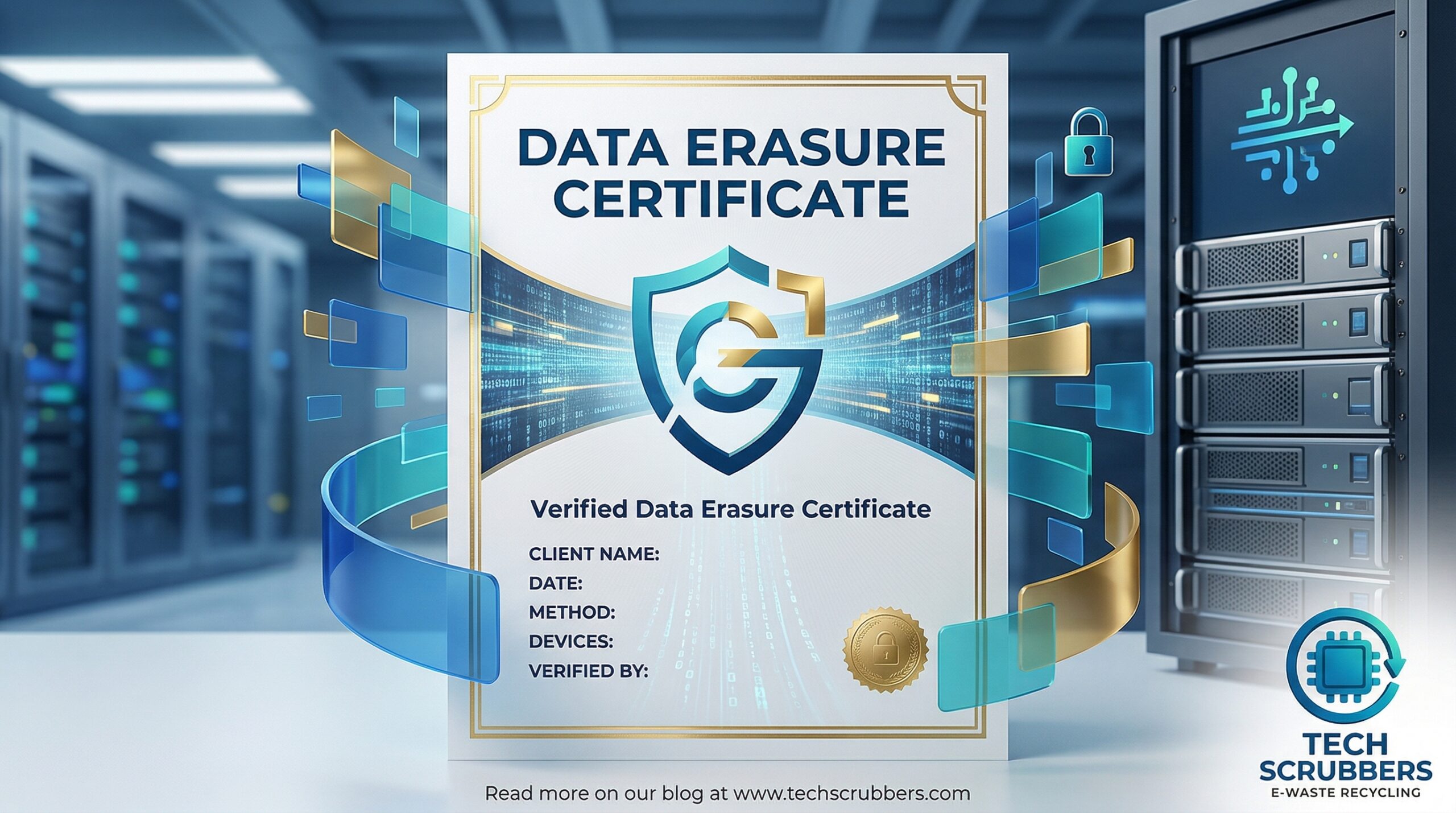
A data erasure certificate is a formal, legally recognised document confirming that data has been permanently and securely removed from a storage device, making it unrecoverable by any means. It acts as the final, auditable record that a specific data sanitisation process was carried out according to recognised industry standards.
What is a Data Erasure Certificate?
This certificate goes beyond simple deletion. It confirms that the storage media underwent a thorough sanitisation process designed to eliminate all residual data traces (data remanence). For businesses disposing of IT equipment, migrating systems, or decommissioning servers, this document is key to demonstrating due diligence.
What Information is Included in a Data Erasure Certificate?
A good certificate provides a clear, traceable audit trail. Key details usually include:
- Service Provider Details: The name and contact information of the company that performed the erasure (e.g., TechScrubbers.co.uk).
- Client Identification: The name and contact details of the organisation whose data was erased.
- Device Identification: Unique identifiers for every piece of hardware processed, such as serial numbers, model numbers, and asset tags.
- Data Erasure Method: Specification of the exact software or technique used (e.g., Blancco, or a specific overwrite pattern).
- Verification Confirmation: A statement confirming the successful completion and verification of the erasure process.
- Date of Erasure: The precise date the sanitisation was performed.
- Standard Adherence: Reference to the specific data sanitisation standard followed (e.g., NIST 800-88).
- Authorisation: A signature or digital stamp from an authorised representative of the erasure provider.
Why is a Data Erasure Certificate Important?
The value of this document covers security, finance, and reputation:
- Auditability and Compliance: It provides clear evidence to regulators, auditors, or clients that you have met your legal obligations regarding data protection.
- Legal Protection: If a future data breach is traced back to improperly disposed hardware, the certificate shows you exercised due diligence in data removal.
- Assurance: It offers certainty that sensitive corporate, financial, or personal data cannot be recovered from retired assets.
The Legal and Regulatory Framework in the UK
For UK businesses, data disposal is controlled by strict legislation designed to protect personal and sensitive information.
GDPR and Data Erasure
The General Data Protection Regulation (GDPR) requires organisations (Data Controllers) to implement suitable technical and organisational measures to secure personal data, including its safe disposal. A data erasure certificate is the main evidence that this requirement has been met for physical media.
Data Protection Act 2018
The Data Protection Act 2018 puts the GDPR framework into UK law. It supports the principle that personal data must be processed lawfully, fairly, and transparently, making documented, verifiable erasure procedures essential.
WEEE Directive and Data Security
The Waste Electrical and Electronic Equipment (WEEE) Directive sets targets for collecting, recycling, and recovering electronic waste. Secure data erasure is a necessary step for responsible WEEE recycling, ensuring data security is maintained throughout the entire asset lifecycle, from use to final disposal.
Data Erasure Standards and Methods
The credibility of your certificate depends entirely on the standard used to perform the erasure. Simply deleting files or reformatting a drive leaves recoverable data remnants.
Understanding Data Sanitisation Standards
Reputable data erasure services follow internationally recognised benchmarks. Key standards referenced on a professional certificate include:
- NIST SP 800-88 Revision 1: Guidelines for Media Sanitisation, published by the US National Institute of Standards and Technology. This is a globally respected framework defining clear sanitisation levels.
- HMG IS5: The standard defined by the UK Government for data sanitisation, often required for public sector contracts.
- ADISA (Asset Disposal & Information Security Alliance): ADISA certification is a recognised benchmark for data sanitisation providers, focusing heavily on process integrity and auditability within the IT Asset Disposition (ITAD) sector.
- ISO 27001: While this covers Information Security Management Systems, adherence to it implies a strong framework for managing data security risks, including disposal.
Common Data Erasure Methods
Data sanitisation involves several techniques, each suited for different media:
- Software-Based Data Erasure: Overwriting the storage media multiple times with specific binary patterns. This is the standard method for modern HDDs and SSDs when the device is to be reused or recycled.
- Degaussing: Applying an extremely powerful magnetic field to make magnetic media (like traditional HDDs) completely unusable and the data unrecoverable. This method does not work on solid-state drives (SSDs).
- Physical Destruction: Shredding, crushing, or incinerating the storage device. This is the most secure method but prevents reuse and is less environmentally friendly.
The choice depends on the storage media. For example, modern SSDs require specific software commands (like Secure Erase or TRIM) to ensure all memory blocks are cleared, a process that differs significantly from erasing a traditional Hard Disk Drive (HDD).
DIY Data Erasure vs. Professional Data Erasure Services
Many businesses try to handle data erasure internally, but this often introduces significant, hard-to-measure risks.
The Risks of DIY Data Erasure
Attempting to erase data without professional tools or expertise carries serious consequences:
- Incomplete Erasure: Standard deletion or formatting leaves data easily recoverable using common forensic tools.
- Lack of Verification: Without certified software, you cannot definitively prove the erasure was successful across all sectors of the drive.
- Compliance Failure: Auditors will not accept internal, undocumented processes as proof of GDPR compliance.
- Reputational Damage: A data leak resulting from poor disposal practices can severely harm client trust.
The Benefits of Professional Data Erasure Services
Partnering with a certified provider like TechScrubbers.co.uk reduces these risks by offering:
- Guaranteed Expertise: Use of industry-leading, certified erasure software that meets strict standards.
- Full Verification and Audit Trails: Every erasure is logged, verified, and documented.
- Regulatory Assurance: Confidence that the process meets the requirements of the Data Protection Act 2018 and GDPR.
- The Data Erasure Certificate: The final, legally sound document confirming compliance.
Checklist for Choosing a Data Erasure Service
When evaluating providers, confirm they can verify the following:
| Criterion | Check |
|---|---|
| Certifications | Are they certified by recognised bodies (e.g., ADISA)? |
| Standards Adherence | Do they guarantee erasure to NIST 800-88 or HMG IS5? |
| Verification | Do they provide verifiable, auditable reports for every device? |
| Media Expertise | Can they securely erase HDDs, SSDs, and mobile devices? |
| Documentation | Is a comprehensive Data Erasure Certificate guaranteed? |
Data Erasure for Different Types of Devices
Data security protocols must adapt to the underlying technology of the storage medium.
Hard Drives (HDDs)
Traditional HDDs are effectively erased using multi-pass overwriting methods or degaussing (if the drive is not being reused).
Solid-State Drives (SSDs)
SSDs present unique challenges due to wear-levelling and over-provisioning. Simple overwriting is often not enough. Secure erasure requires using the drive’s internal firmware commands (like Secure Erase or TRIM) to ensure all NAND cells are cleared.
USB Drives and Mobile Devices
These smaller media require specialised tools capable of interfacing with their unique controllers. Secure erasure on smartphones often involves cryptographic erasure if the device supports hardware encryption, or a full factory reset verified against industry standards.
The Data Erasure Process with TechScrubbers.co.uk
TechScrubbers.co.uk provides end-to-end data security, ensuring compliance and environmental responsibility, particularly for businesses across Manchester and the wider UK.
Our Data Erasure Process
Our process is straightforward and designed for maximum security:
- Asset Collection & Logging: Devices are securely collected, and all serial numbers are logged against the client’s asset register.
- Data Erasure Execution: We use industry-leading, certified software to perform the erasure process, tailored to the specific media type (HDD, SSD, etc.).
- Verification and Reporting: Each device undergoes a verification scan to confirm the erasure was successful. A detailed log is generated.
- Certificate Issuance: Upon successful verification, we issue the formal data erasure certificate for your records.
- Responsible Disposition: Devices that cannot be reused are recycled in line with WEEE regulations, promoting sustainability.
The Data Erasure Certificate You’ll Receive
The certificate issued by TechScrubbers.co.uk is your definitive proof of compliance. It clearly links the serial number of the retired asset to the successful execution of a recognised sanitisation standard, providing the necessary documentation for any regulatory review.
Benefits of Choosing TechScrubbers.co.uk
As a UK-based specialist, we offer:
- Local Expertise: Deep understanding of UK data protection laws and regulatory expectations.
- Certified Methods: Commitment to using audited, verifiable erasure techniques.
- Full Traceability: Complete chain of custody documentation from collection to certification.
Frequently Asked Questions (FAQs)
Data erasure securely removes data so the device can be reused or recycled responsibly. Data destruction physically destroys the device, making reuse impossible but guaranteeing data loss.
No. Formatting only removes the file system pointers, leaving the underlying data intact and easily recoverable.
This depends on the volume of data and the method used. Software erasure on modern drives can take several hours per device, while physical destruction is instantaneous.
After certification, devices are either securely wiped and remarketed (if viable) or responsibly recycled via our WEEE-compliant channels.
In the current regulatory climate, relying on guesswork for data disposal is a liability. The data erasure certificate is not optional; it is a fundamental requirement for showing accountability under GDPR and the Data Protection Act 2018.
Ensure Your Compliance Today