Category: Data Erasure Services

  • Data Destruction Methods Comparison (Software vs. Physical)

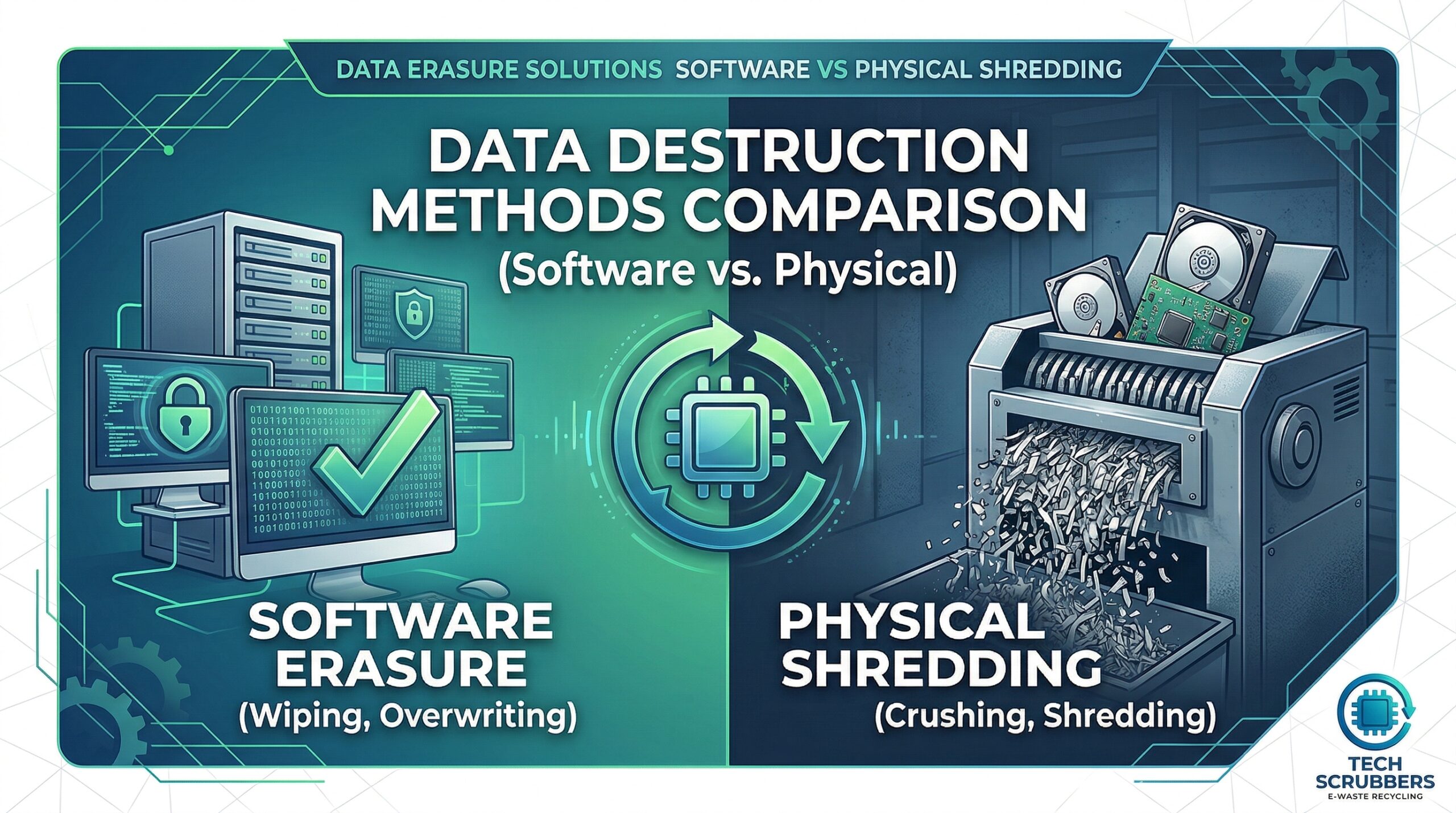
    Data Destruction Methods Comparison (Software vs. Physical)

    Data Erasure Solutions Software vs Physical Shredding

    Secure your business assets with industry-leading compliance and destruction methods.

    Get A Quote Today

    Choosing the Right Method for Your Business

    With data protection regulations becoming increasingly strict, permanently removing sensitive information from retired IT assets is a priority for every business. Whether you are upgrading your infrastructure or decommissioning old hardware, choosing between data erasure solutions software vs physical shredding affects your compliance, budget, and environmental impact.

    Understanding Data Destruction

    Data destruction renders information stored on electronic devices unrecoverable. Because the UK GDPR imposes heavy penalties for data breaches, businesses must ensure their end-of-life IT processes are secure, verifiable, and fully compliant.

    Software-Based Data Erasure

    Data erasure, or sanitisation, uses software to overwrite every sector of a storage device with random patterns, scrambling the original data until it cannot be recovered.

    The Advantages

    • Asset Reusability: Keep hardware intact for resale or internal redeployment.
    • Environmental Impact: Supports circular economy goals by reducing e-waste.
    • Verification: Receive a tamper-proof certificate of erasure for every device.
    Explore Erasure Services

    Physical Data Destruction

    Physical destruction involves mechanically or magnetically altering a storage device so it can never be read again, including industrial shredding and degaussing.

    When to Choose Physical Destruction

    • Maximum Security: Ideal for highly sensitive or classified data.
    • Damaged Assets: The only reliable method for faulty or non-functional drives.
    • Definitive Proof: Physical remains serve as tangible evidence of destruction.
    Learn About Shredding

    Comparison: Key Considerations

    Feature Software-Based Erasure Physical Shredding
    Asset Recovery High None
    Security Level High (Standard-compliant) Maximum (Irreversible)
    Environmental Impact Positive Negative

    Secure IT Asset Disposition with Techscrubbers

    At Techscrubbers, we provide certified data destruction services tailored to your security needs. Whether you require on-site shredding or software-based erasure, our team ensures full compliance with UK data protection standards.

    Why Choose Us Contact Our Team
  • Secure Computer Disposal for Manchester Businesses: A Checklist

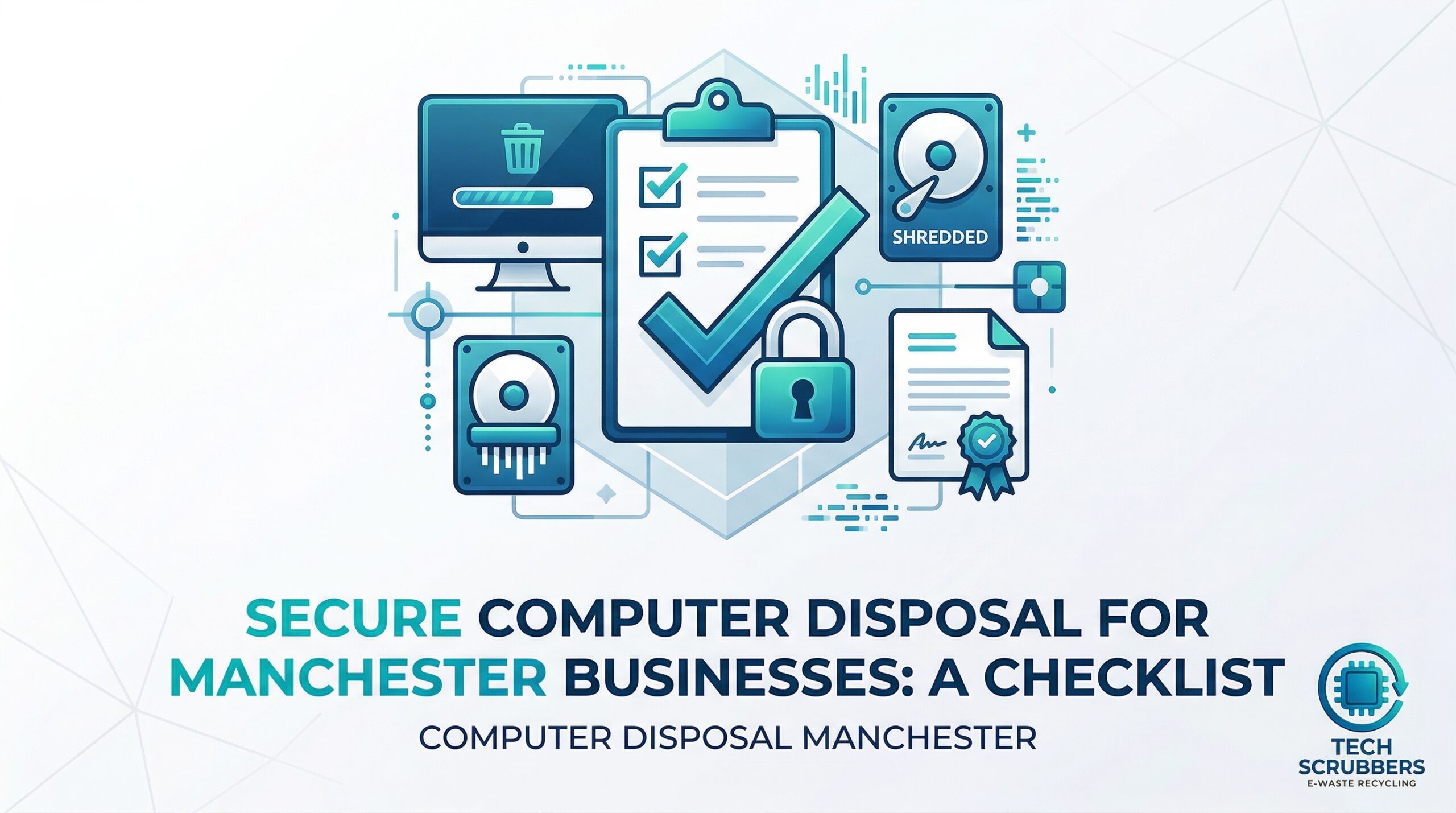
    Secure Computer Disposal for Manchester Businesses: A Checklist

    Secure Computer Disposal Manchester

    Protect your data and stay compliant with professional IT asset disposal services.

    Get A Free Consultation

    Secure Computer Disposal for Manchester Businesses: A Checklist

    For Manchester businesses, managing end-of-life IT equipment is more than a routine waste task; it is a legal and security necessity. Improperly discarded hardware can lead to data breaches, heavy regulatory fines, and environmental harm.

    This guide outlines the steps your organisation should take to manage computer disposal in Manchester, ensuring you stay compliant with UK law while keeping sensitive data secure.

    Why Secure Computer Disposal Matters

    Data Security

    A standard “delete” or “format” command does not permanently remove data. Ensure your sensitive information is irrecoverable with certified data erasure services.

    WEEE Compliance

    The WEEE Regulations dictate how businesses must handle electronic waste — you remain legally responsible for your equipment until it reaches a licensed facility. New to the rules? Read what WEEE means for UK businesses.

    Environmental Responsibility

    Responsible IT recycling in Manchester recovers valuable components and neutralises hazardous materials, helping Manchester meet its sustainability goals.

    Your Computer Disposal Checklist

    1. Inventory and Assessment: Categorise items by age, condition, and data sensitivity. Don’t forget servers and networking kit — see server disposal for anything rack-mounted.
    2. Data Sanitisation Planning: Decide between software-based erasure or physical destruction — our methods comparison explains the trade-offs.
    3. Data Erasure Execution: Use certified methods to process all storage media, on-site or off-site — see data destruction in Manchester.
    4. Verification and Certification: Obtain a formal Certificate of Destruction for every device.
    5. Responsible Recycling: Ensure your partner holds valid waste carrier licences.
    6. Employee Training: Prevent data leaks by training staff on proper disposal procedures.
    7. Documentation: Keep a central record of all disposal activities for GDPR compliance.

    Choosing an ITAD Partner in Manchester

    When selecting a provider, look for recognised erasure standards (NIST 800-88, HMG IS5), clear chain-of-custody procedures, and a proven track record with local Manchester-based businesses. Our IT asset disposal Manchester service covers the full checklist above — with most collections free.

    TechScrubbers: Your Partner for Computer Disposal

    At TechScrubbers, we provide secure, compliant, and environmentally responsible IT asset disposal for businesses across Manchester. We use proven data destruction techniques and maintain a focus on sustainability.

  • On-Site vs. Off-Site Data Destruction: A Complete Comparison

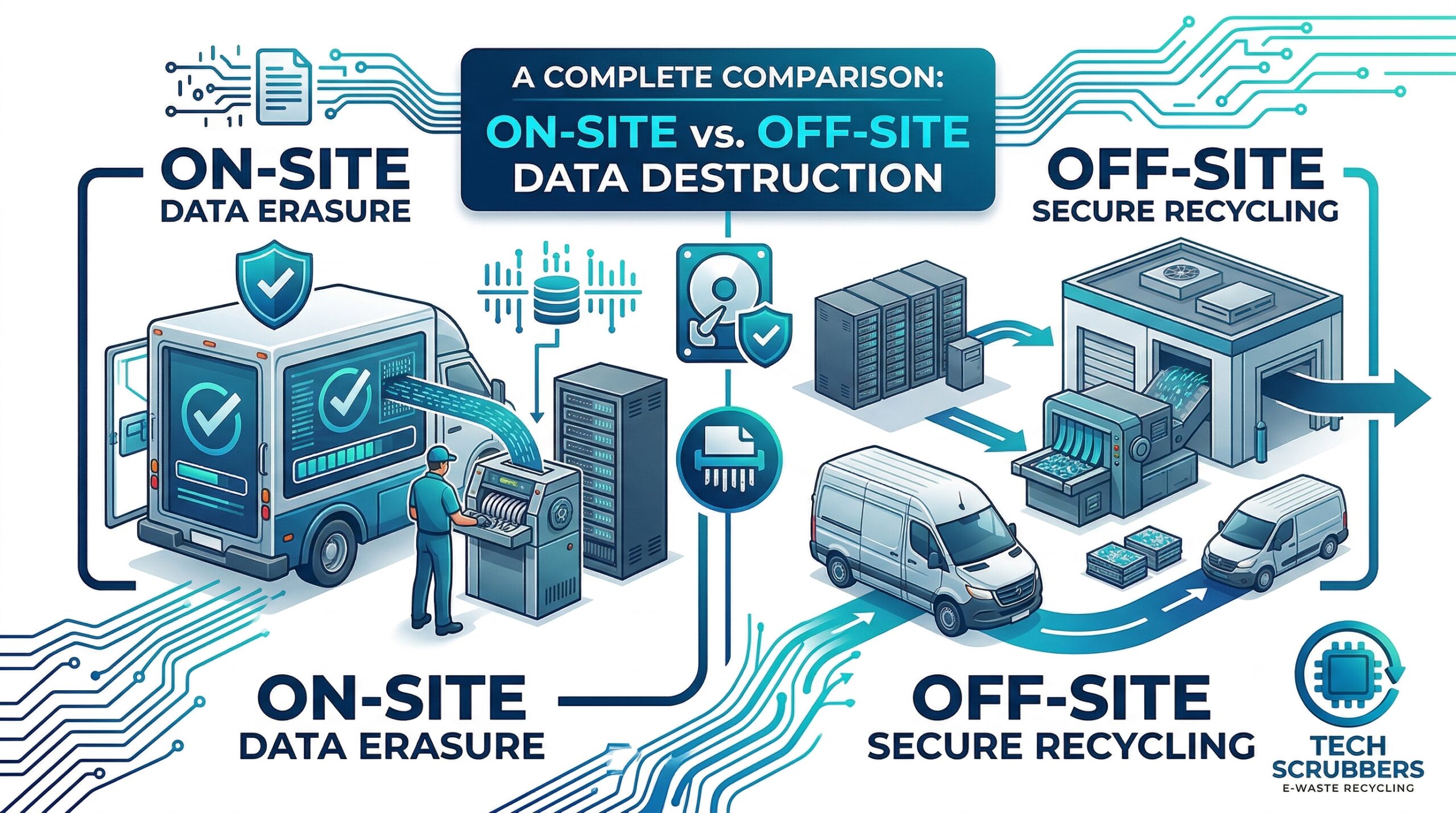
    On-Site vs. Off-Site Data Destruction: A Complete Comparison

    On-Site vs. Off-Site Data Destruction: A Guide for UK Businesses

    Ensure your organisation remains secure and compliant with professional on-site data erasure.

    Book Your On-Site Service

    With data privacy regulations becoming increasingly strict, secure IT asset disposal is no longer a back-office task; it is a core business requirement. Whether you are upgrading servers, replacing laptops, or decommissioning mobile devices, your chosen method for data sanitisation directly affects your risk profile. For many organisations, on-site data erasure has become the preferred method for maintaining total control over sensitive information.

    Why Data Destruction Matters

    Data destruction is the process of making information on storage devices unrecoverable. It is a fundamental part of IT Asset Disposition (ITAD). Under the UK General Data Protection Regulation (UK GDPR) and the Data Protection Act 2018, organisations are legally responsible for protecting personal data throughout its entire lifecycle, including the point of disposal.

    On-Site Data Destruction: Maintaining Control

    On-site destruction involves performing the sanitisation process at your own premises. This removes the risks associated with transporting sensitive hardware to a third-party facility.

    On-Site Data Erasure (Software-Based)

    On-site data erasure uses specialised software to overwrite every sector of a storage device with non-sensitive data. When done correctly, this makes the original information unrecoverable, even with forensic tools. Reputable providers follow international standards like NIST 800-88, ensuring the process is verifiable and audit-ready.

    On-Site Physical Destruction

    For faulty or redundant devices, physical destruction—such as industrial shredding, crushing, or degaussing—is the most definitive method. By shredding hard drives into fragments on-site, you ensure the media is destroyed before it leaves your sight.

    Off-Site Data Destruction: Outsourcing Security

    Off-site destruction involves a vendor collecting your IT assets and transporting them to a secure facility. While often marketed as a convenient solution, it introduces variables that businesses should carefully consider.

    On-Site vs. Off-Site: Comparison

    Feature On-Site Destruction Off-Site Destruction
    Security High: Data stays on-site. Moderate: Risk during transit.
    Chain of Custody Direct and transparent. Dependent on third-party logistics.

    Techscrubbers: Your Partner for On-Site Data Erasure

    At Techscrubbers, we specialise in secure, on-site data erasure for UK businesses. We know your data is a critical asset, and our goal is to ensure it remains protected until the moment it is erased. By bringing our certified processes directly to your facility, we provide the security and compliance that modern organisations need.

    View Our Certification Process Read Our Full Guide
  • What is a Data Erasure Certificate and Why You Need One

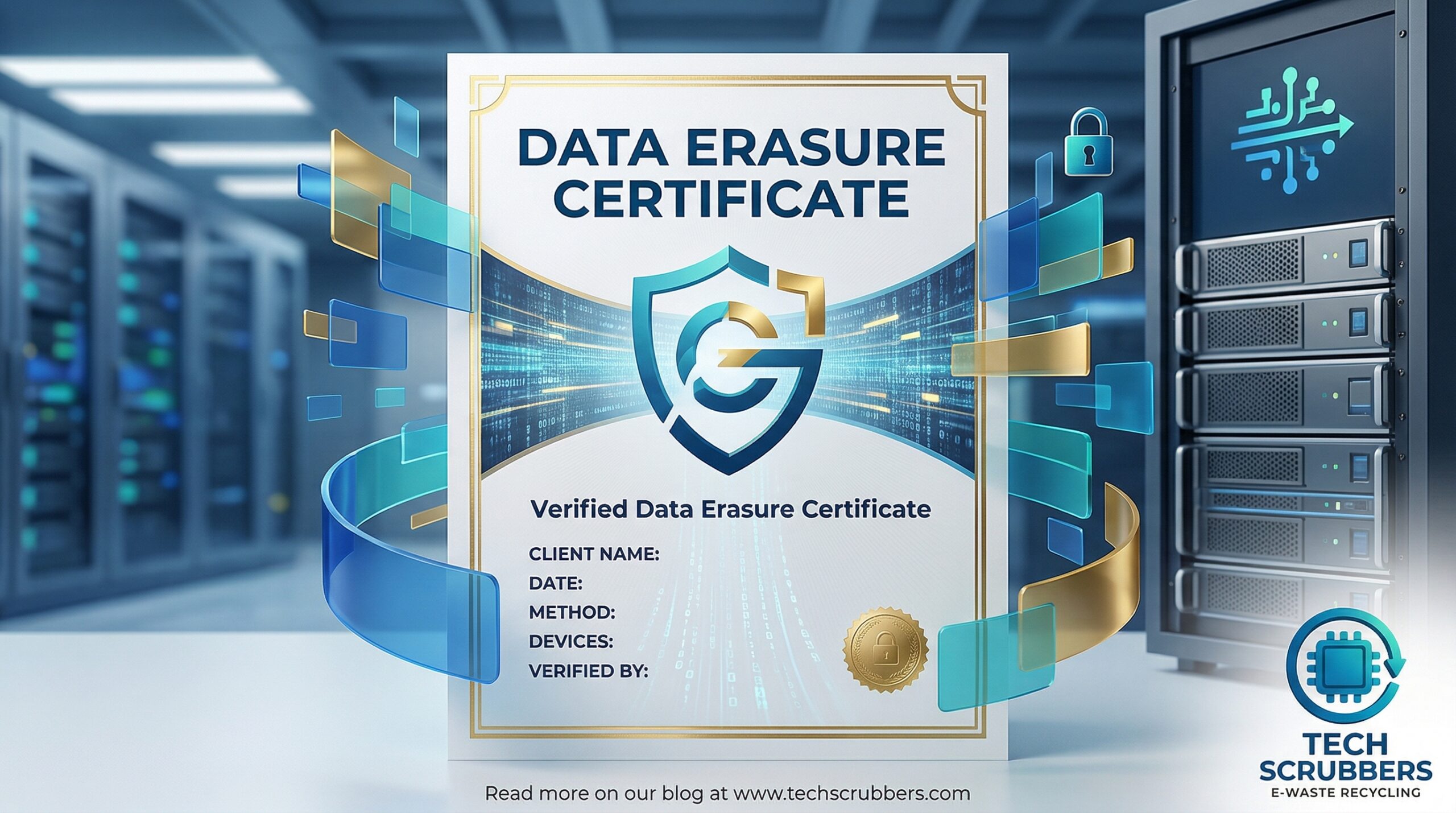
    What is a Data Erasure Certificate and Why You Need One

    The Data Erasure Certificate: Your Essential Proof of Secure Data Disposal in the UK

    For any organisation handling sensitive information, securely disposing of IT assets is not just an administrative task—it’s a critical compliance requirement. This proof comes in the form of a data erasure certificate.

    Get Your Compliance Documentation

    When retiring, repurposing, or recycling hardware, you need solid proof that data is gone for good. This guide explains what a data erasure certificate involves, why it is necessary for meeting UK regulatory standards like GDPR, and how professional services ensure your data disposal process is fully auditable and compliant.

    Understanding Data Erasure Certificates

    A data erasure certificate is a formal, legally recognised document confirming that data has been permanently and securely removed from a storage device, making it unrecoverable by any means. It acts as the final, auditable record that a specific data sanitisation process was carried out according to recognised industry standards.

    What is a Data Erasure Certificate?

    This certificate goes beyond simple deletion. It confirms that the storage media underwent a thorough sanitisation process designed to eliminate all residual data traces (data remanence). For businesses disposing of IT equipment, migrating systems, or decommissioning servers, this document is key to demonstrating due diligence.

    What Information is Included in a Data Erasure Certificate?

    A good certificate provides a clear, traceable audit trail. Key details usually include:

    • Service Provider Details: The name and contact information of the company that performed the erasure (e.g., TechScrubbers.co.uk).
    • Client Identification: The name and contact details of the organisation whose data was erased.
    • Device Identification: Unique identifiers for every piece of hardware processed, such as serial numbers, model numbers, and asset tags.
    • Data Erasure Method: Specification of the exact software or technique used (e.g., Blancco, or a specific overwrite pattern).
    • Verification Confirmation: A statement confirming the successful completion and verification of the erasure process.
    • Date of Erasure: The precise date the sanitisation was performed.
    • Standard Adherence: Reference to the specific data sanitisation standard followed (e.g., NIST 800-88).
    • Authorisation: A signature or digital stamp from an authorised representative of the erasure provider.

    Why is a Data Erasure Certificate Important?

    The value of this document covers security, finance, and reputation:

    1. Auditability and Compliance: It provides clear evidence to regulators, auditors, or clients that you have met your legal obligations regarding data protection.
    2. Legal Protection: If a future data breach is traced back to improperly disposed hardware, the certificate shows you exercised due diligence in data removal.
    3. Assurance: It offers certainty that sensitive corporate, financial, or personal data cannot be recovered from retired assets.

    Data Erasure Standards and Methods

    The credibility of your certificate depends entirely on the standard used to perform the erasure. Simply deleting files or reformatting a drive leaves recoverable data remnants.

    Understanding Data Sanitisation Standards

    Reputable data erasure services follow internationally recognised benchmarks. Key standards referenced on a professional certificate include:

    • NIST SP 800-88 Revision 1: Guidelines for Media Sanitisation, published by the US National Institute of Standards and Technology. This is a globally respected framework defining clear sanitisation levels.
    • HMG IS5: The standard defined by the UK Government for data sanitisation, often required for public sector contracts.
    • ADISA (Asset Disposal & Information Security Alliance): ADISA certification is a recognised benchmark for data sanitisation providers, focusing heavily on process integrity and auditability within the IT Asset Disposition (ITAD) sector.
    • ISO 27001: While this covers Information Security Management Systems, adherence to it implies a strong framework for managing data security risks, including disposal.

    Common Data Erasure Methods

    Data sanitisation involves several techniques, each suited for different media:

    • Software-Based Data Erasure: Overwriting the storage media multiple times with specific binary patterns. This is the standard method for modern HDDs and SSDs when the device is to be reused or recycled.
    • Degaussing: Applying an extremely powerful magnetic field to make magnetic media (like traditional HDDs) completely unusable and the data unrecoverable. This method does not work on solid-state drives (SSDs).
    • Physical Destruction: Shredding, crushing, or incinerating the storage device. This is the most secure method but prevents reuse and is less environmentally friendly.

    The choice depends on the storage media. For example, modern SSDs require specific software commands (like Secure Erase or TRIM) to ensure all memory blocks are cleared, a process that differs significantly from erasing a traditional Hard Disk Drive (HDD).

    DIY Data Erasure vs. Professional Data Erasure Services

    Many businesses try to handle data erasure internally, but this often introduces significant, hard-to-measure risks.

    The Risks of DIY Data Erasure

    Attempting to erase data without professional tools or expertise carries serious consequences:

    • Incomplete Erasure: Standard deletion or formatting leaves data easily recoverable using common forensic tools.
    • Lack of Verification: Without certified software, you cannot definitively prove the erasure was successful across all sectors of the drive.
    • Compliance Failure: Auditors will not accept internal, undocumented processes as proof of GDPR compliance.
    • Reputational Damage: A data leak resulting from poor disposal practices can severely harm client trust.

    The Benefits of Professional Data Erasure Services

    Partnering with a certified provider like TechScrubbers.co.uk reduces these risks by offering:

    • Guaranteed Expertise: Use of industry-leading, certified erasure software that meets strict standards.
    • Full Verification and Audit Trails: Every erasure is logged, verified, and documented.
    • Regulatory Assurance: Confidence that the process meets the requirements of the Data Protection Act 2018 and GDPR.
    • The Data Erasure Certificate: The final, legally sound document confirming compliance.

    Checklist for Choosing a Data Erasure Service

    When evaluating providers, confirm they can verify the following:

    Criterion Check
    Certifications Are they certified by recognised bodies (e.g., ADISA)?
    Standards Adherence Do they guarantee erasure to NIST 800-88 or HMG IS5?
    Verification Do they provide verifiable, auditable reports for every device?
    Media Expertise Can they securely erase HDDs, SSDs, and mobile devices?
    Documentation Is a comprehensive Data Erasure Certificate guaranteed?

    Data Erasure for Different Types of Devices

    Data security protocols must adapt to the underlying technology of the storage medium.

    Hard Drives (HDDs)

    Traditional HDDs are effectively erased using multi-pass overwriting methods or degaussing (if the drive is not being reused).

    Solid-State Drives (SSDs)

    SSDs present unique challenges due to wear-levelling and over-provisioning. Simple overwriting is often not enough. Secure erasure requires using the drive’s internal firmware commands (like Secure Erase or TRIM) to ensure all NAND cells are cleared.

    USB Drives and Mobile Devices

    These smaller media require specialised tools capable of interfacing with their unique controllers. Secure erasure on smartphones often involves cryptographic erasure if the device supports hardware encryption, or a full factory reset verified against industry standards.

    The Data Erasure Process with TechScrubbers.co.uk

    TechScrubbers.co.uk provides end-to-end data security, ensuring compliance and environmental responsibility, particularly for businesses across Manchester and the wider UK.

    Our Data Erasure Process

    Our process is straightforward and designed for maximum security:

    1. Asset Collection & Logging: Devices are securely collected, and all serial numbers are logged against the client’s asset register.
    2. Data Erasure Execution: We use industry-leading, certified software to perform the erasure process, tailored to the specific media type (HDD, SSD, etc.).
    3. Verification and Reporting: Each device undergoes a verification scan to confirm the erasure was successful. A detailed log is generated.
    4. Certificate Issuance: Upon successful verification, we issue the formal data erasure certificate for your records.
    5. Responsible Disposition: Devices that cannot be reused are recycled in line with WEEE regulations, promoting sustainability.

    The Data Erasure Certificate You’ll Receive

    The certificate issued by TechScrubbers.co.uk is your definitive proof of compliance. It clearly links the serial number of the retired asset to the successful execution of a recognised sanitisation standard, providing the necessary documentation for any regulatory review.

    Benefits of Choosing TechScrubbers.co.uk

    As a UK-based specialist, we offer:

    • Local Expertise: Deep understanding of UK data protection laws and regulatory expectations.
    • Certified Methods: Commitment to using audited, verifiable erasure techniques.
    • Full Traceability: Complete chain of custody documentation from collection to certification.

    Frequently Asked Questions (FAQs)

    What is the difference between data erasure and data destruction?

    Data erasure securely removes data so the device can be reused or recycled responsibly. Data destruction physically destroys the device, making reuse impossible but guaranteeing data loss.

    Is formatting a hard drive enough to erase data?

    No. Formatting only removes the file system pointers, leaving the underlying data intact and easily recoverable.

    How long does data erasure take?

    This depends on the volume of data and the method used. Software erasure on modern drives can take several hours per device, while physical destruction is instantaneous.

    What happens to the devices after data erasure?

    After certification, devices are either securely wiped and remarketed (if viable) or responsibly recycled via our WEEE-compliant channels.

    In the current regulatory climate, relying on guesswork for data disposal is a liability. The data erasure certificate is not optional; it is a fundamental requirement for showing accountability under GDPR and the Data Protection Act 2018.

    Ensure Your Compliance Today
  • Data Destruction Manchester — Secure On-Site & Off-Site Services

    Data Destruction Manchester — Secure On-Site & Off-Site Services

    Data Destruction Manchester: Secure On-Site & Off-Site Services

    Certified data destruction for Manchester businesses — at your premises or our secure Stretford facility. Hard drives erased to NIST 800-88 or physically shredded, with a Certificate of Data Destruction for every device. Complete control, full GDPR compliance, zero doubt.

    Why Manchester Businesses Choose On-Site Destruction

    On-site data destruction gives you direct oversight of the entire process — sensitive media never leaves your building until the data on it is gone. For everything else, our tracked off-site service offers the same certainty with less disruption. Not sure which fits? Read our on-site vs off-site comparison.

    🔒

    Witnessed Security

    Watch the destruction happen at your premises — no transport risk, no chain-of-custody gaps.

    ⚖️

    GDPR & DPA 2018 Compliance

    Documented, certified destruction that satisfies UK data protection law and your auditors.

    📍

    Genuinely Local

    Based in Stretford, covering Manchester city centre, Salford, Trafford, Stockport and all of Greater Manchester.

    Complete Audit Trail

    A Certificate of Data Destruction for every serialised device.

    Three Destruction Methods, One Standard: Irretrievable

    💻

    Certified Software Erasure

    Verified overwriting to NIST 800-88 and HMG IS5 — data destroyed, hardware preserved for reuse or resale value. See our full data erasure services.

    🧲

    Degaussing

    Powerful magnetic fields scramble data on magnetic media — hard drives and tapes — beyond any recovery.

    ⚙️

    Physical Hard Drive Shredding

    Drives, SSDs and media pulverised into fragments — the definitive end for devices that can’t or shouldn’t be reused. Compare methods in our software vs physical guide.

    How It Works

    1

    Consultation & Assessment

    We scope your devices, security requirements and compliance needs, then recommend on-site or off-site and the right destruction method for each media type.

    2

    Secure Chain of Custody

    Every item is logged and tracked from first touch — whether we’re working in your building or transporting to our Stretford facility in tracked vehicles.

    3

    Destruction — Witnessed if On-Site

    Certified technicians erase, degauss or shred under your supervision on-site, or at our secure facility with full documentation.

    4

    Certification & Responsible Recycling

    You receive your Certificate of Data Destruction; destroyed materials are recycled compliantly and reusable hardware re-enters the circular economy via our IT recycling Manchester service.

    Who We Help

    From five-desk offices to server room decommissions, we provide data destruction for Manchester’s finance, legal, healthcare, education, public-sector and technology organisations — anywhere sensitive data lives on retiring hardware. Clearing more than drives? See IT asset disposal Manchester and server disposal.

    Data Destruction Manchester — FAQs

    Do you offer hard drive destruction in Manchester?

    Yes — physical destruction of HDDs and SSDs, on-site at your premises so you can witness it, or at our secure Stretford facility with full chain of custody.

    What devices can you destroy?

    HDDs, SSDs, magnetic tapes, USB drives, optical media, phones and tablets. Working drives can be certified-erased instead, preserving hardware value.

    Do we get a certificate?

    Every serialised device receives a Certificate of Data Destruction with method and verification status — essential for GDPR audits.

    What does it cost?

    Depends on volume and method. Where devices hold resale value, certified erasure plus refurbishment can make the service free — or earn a rebate. Get a free quote.

    Book Secure Data Destruction in Manchester

    Free quotes, fast scheduling, and certainty your data is gone for good.

    Request Your Free Quote
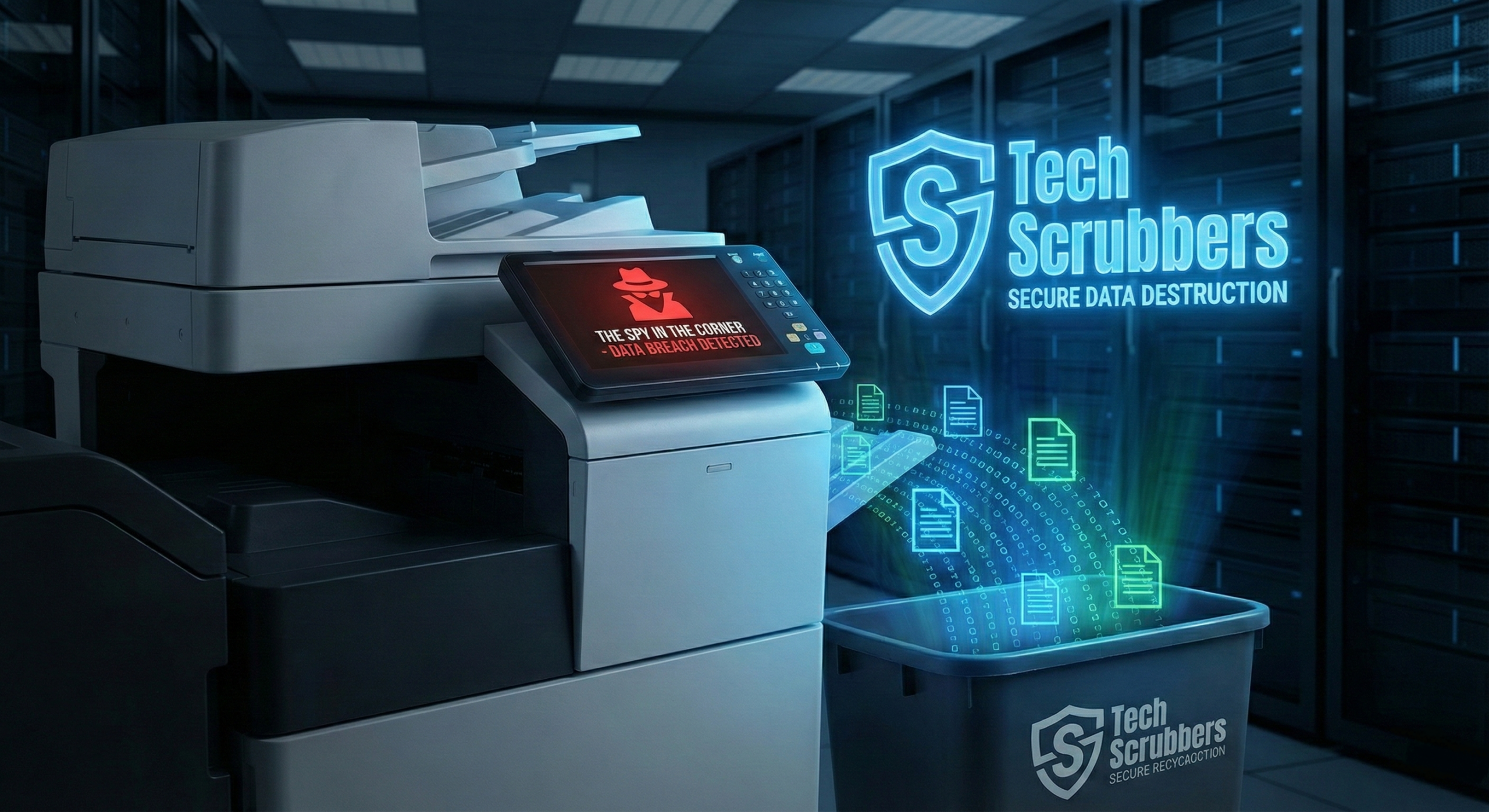
  • The Spy in the Corner – Printer Hard Drive Wiping

    The Spy in the Corner – Printer Hard Drive Wiping

    Cyber Security Alert

    The Spy in the Corner: Why Your Office Printer is Your Biggest Data Leak

    It remembers every scan, every invoice, and every passport. And you probably just sold it on eBay.

    Picture this: You’ve just completed a major office upgrade in Manchester. The old laptops have been professionally wiped by a certified team. The servers have been physically destroyed. You are 100% GDPR compliant.

    Or so you think.

    While you were focusing on the computers, the large multifunction printer (MFP) in the hallway was loaded onto a van and sold to a second-hand dealer. Nobody touched it. It’s just a printer, right?

    Wrong. That printer contains a hard drive. And on that hard drive is a digital image of every single document you have scanned, copied, or printed in the last three years.

    The Anatomy of a Hidden Breach

    Modern office equipment isn’t just mechanical; it is a sophisticated computer with a paper tray. These devices use Non-Volatile Random Access Memory (NVRAM) and internal HDDs to store job logs, address books, and cached document images.

    This isn’t paranoia; it is a documented security flaw. When these devices lose power, the data does not vanish. It sits there, waiting for the next owner to hit “Print Log”.

    > CONNECTING TO DEVICE: CANON-IR-ADVANCE-C5535
    > ACCESS LEVEL: ADMIN (DEFAULT PASSWORD)
    > MOUNTING HDD VOLUME… SUCCESS.
    > SCANNING SECTOR 001-999…

    [!] 4,203 FILES FOUND.
    > FILE TYPE: .PDF (OCR)
    > CONTENT SAMPLE:
      – “Payroll_Aug_2025.pdf”
      – “CEO_Passport_Scan_Color.jpg”
      – “Confidential_Merger_Draft_v2.docx”

    > STATUS: FULLY RECOVERABLE

    If you don’t specifically target these devices for Certified Data Erasure, you are essentially handing your most sensitive intellectual property directly to the highest bidder.

    The “Hidden 4” Devices You Forgot to Wipe

    It’s not just printers. Your office is full of “Smart” devices (IoT) that hoard data. At Tech Scrubbers, we include these in our standard “Hidden Asset” audit—something most basic recycling firms ignore.

    🖨️

    Multifunction Printers

    The Threat: Internal HDDs store copies of scans and prints.

    The Data: Invoices, HR records, contracts, and network Wi-Fi passwords.

    📞

    VoIP Phones

    The Threat: On-board storage for call logs and contacts.

    The Data: Client phone numbers, recorded voicemails, and call metadata.

    📺

    Smart TVs & Boards

    The Threat: Cached login tokens and session data.

    The Data: Presentation slides, browser history, and saved passwords for streaming apps.

    🛰️

    Network Switches

    The Threat: Configuration files stored in flash memory.

    The Data: Network topology maps and encryption keys that hackers love.

    How to Fix It (The Tech Scrubbers Way)

    Factory resetting a printer usually only clears the user settings, not the hard drive data. To be safe, you need a forensic approach. Here is how we handle “Hidden Data” during an Office IT Clearance:

    • Identify: We create an asset register that includes ALL powered devices, not just computers.
    • Isolate: We disconnect devices from the network before decommissioning to prevent last-minute cloud syncs.
    • Purge: We use specialist software (like Blancco) designed for printer sanitisation, or physically remove and shred the drive.
    • Verify: Your Certificate of Destruction will explicitly list the printer’s serial number, proving compliance to auditors.

    Don’t Let Your Printer Talk.

    Get a free “Hidden Asset” Audit included with your next collection in Manchester. Secure your data from the corner office to the copy room.

    Book Your Audit
  • What Is Data Erasure? The Definitive Guide for UK Businesses (2026)

    What Is Data Erasure? The Definitive Guide for UK Businesses (2026)

    Data Erasure Services: The Definitive Guide for UK Businesses

    By Tech Scrubbers Team 10 Min Read

    Deleting a file merely sends it to the recycle bin. Formatting a drive only hides the data from the operating system. To be GDPR compliant, businesses must use professional Data Erasure Services.

    For UK businesses in 2026, this distinction is not just technical; it is legal. A recent study by the ICO found that 67% of second-hand hard drives sold online still contained personally identifiable information (PII). With potential GDPR fines reaching £17.5 million, relying on a “factory reset” is a gamble no Director or IT Manager should take.

    At Tech Scrubbers, we believe that true security goes hand-in-hand with sustainability. This guide will explain exactly what Certified Data Erasure is, how it protects you under UK law, and why it is the only responsible choice for your retired IT assets.

    1. What are Professional Data Erasure Services?

    Data Erasure Services utilise specialist software to overwrite the data on a storage device (HDD, SSD, or mobile) across 100% of its sectors. Unlike a standard “delete” command, this process verifies that the data is irretrievably destroyed while keeping the hardware intact.

    To be compliant, the process must adhere to recognised international standards. At Tech Scrubbers, our Manchester-based operations align with the two most rigorous protocols in the industry:

    NIST 800-88 (Global Gold Standard)

    The National Institute of Standards and Technology defines three levels:

    • Clear: Overwriting user-addressable storage. Sufficient for most standard business devices.
    • Purge: Uses firmware commands to remove data from hidden areas. Required for highly sensitive data.
    • Destroy: Physical destruction (Shredding) when the device cannot be reused.

    HMG InfoSec Standard No. 5

    The UK Government’s own standard for data sanitisation, used by government departments.

    • Baseline: Involves a 1-pass overwrite verification.
    • Enhanced: A complex 3-pass overwrite verification for higher security classifications (OFFICIAL-SENSITIVE).

    The Proof is in the Paperwork

    Any company can claim they wiped your drive. Only a certified partner provides a Certificate of Destruction that stands up to a GDPR audit.

    CERTIFICATE

    Of Data Destruction
    Client Ref: REF-2026-TS
    Date: 19 JAN 2026
    Method: NIST 800-88 (Purge)

    Asset Details:

    1x Dell Latitude 5420 / SN: 8H2K92J

    HDD Serial: WDC-WX41A…

    STATUS: ERASED & VERIFIED

    Example of the documentation you receive for every serialised asset.

    2. GDPR & The Law: Your Obligations

    Under the UK Data Protection Act (2018) and GDPR, you are legally responsible for data until it is irretrievably destroyed.

    Article 17: Right to Erasure

    Often called the “Right to be Forgotten,” this article mandates that personal data must be erased without delay when it is no longer necessary. Simply storing old hard drives in a cupboard violates this principle.

    Article 32: Security of Processing

    This article requires you to implement technical measures to ensure security. Using professional data erasure services demonstrates due diligence and compliance to the ICO.

    3. The Chain of Custody: How We Protect You

    Security isn’t just about software; it’s about logistics. From the moment our team leaves our Stretford, Manchester facility to collect your equipment, every step is tracked.

    1

    Secure Collection

    GPS-tracked vans and uniformed staff collect your assets directly from your premises. We provide a waste transfer note immediately.

    2

    Transit & Audit

    Assets are transported to our secure facility (CCTV monitored 24/7) and logged into our asset management system.

    3

    The Wipe

    Professional software overwrites all data. If a drive fails verification, it is physically shredded to 6mm particles.

    4

    Certification

    You receive your Certificate of Destruction and the hardware enters the reuse stream, supporting the circular economy.

    4. Sustainability: The “Secure Ecology” Approach

    Many businesses assume that physical destruction (shredding) is the most secure method. While effective, it is environmentally costly. Shredding a hard drive destroys the magnets, the aluminium, and the circuitry, turning a functional piece of technology into scrap metal.

    Data Erasure extends the life of tech.

    By choosing software-based erasure, you allow that laptop or server to be refurbished and reused. This supports the Circular Economy, reduces the demand for mining new rare earth materials, and significantly lowers your company’s carbon footprint.

    Did you know?

    Manufacturing a single laptop releases approximately 331kg of CO2. Extending its life by just one year significantly reduces its environmental impact.

    Tech Scrubbers prioritises Reuse over Recycle.

    Specific Solutions for Every Device

    Not all memory is created equal. A server RAID array requires a different erasure protocol than an iPhone. We offer bespoke data erasure services for:

    Servers & Data Centres

    We handle complex RAID arrays and SANs. For high-security environments, we offer on-site erasure, meaning the data never leaves your server room until it is destroyed.

    Mobiles & Tablets

    Factory resets often fail to clear associated cloud accounts (like iCloud locks). Our software removes these locks and sanitises the flash storage permanently.

    SSDs vs HDDs

    Solid State Drives (SSDs) store data differently. We use specific ‘Freeze Lock’ removal and firmware commands to ensure no data hides in over-provisioned cells.

    Frequently Asked Questions

    Is formatting a hard drive the same as erasure?

    No. Formatting simply removes the “address book” that points to your data. The data itself remains on the disk and can be recovered with free software. Secure erasure overwrites the actual data.

    How much do professional data erasure services cost?

    It depends on the volume. However, because we focus on the resale value of the refurbished hardware, we can often perform office clearances and data erasure for free, or even offer a rebate for high-value assets.

    Can I just drill a hole in the hard drive?

    While physically damaging a drive makes data recovery harder, it is not GDPR compliant without a certificate. Furthermore, modern SSDs are tiny chips; drilling a hole in the casing might miss the memory chip entirely.

    Ready to secure your data?

    Protect your business and the planet. Contact our Manchester team today for a custom quote and compliance consultation.