
Tag: News

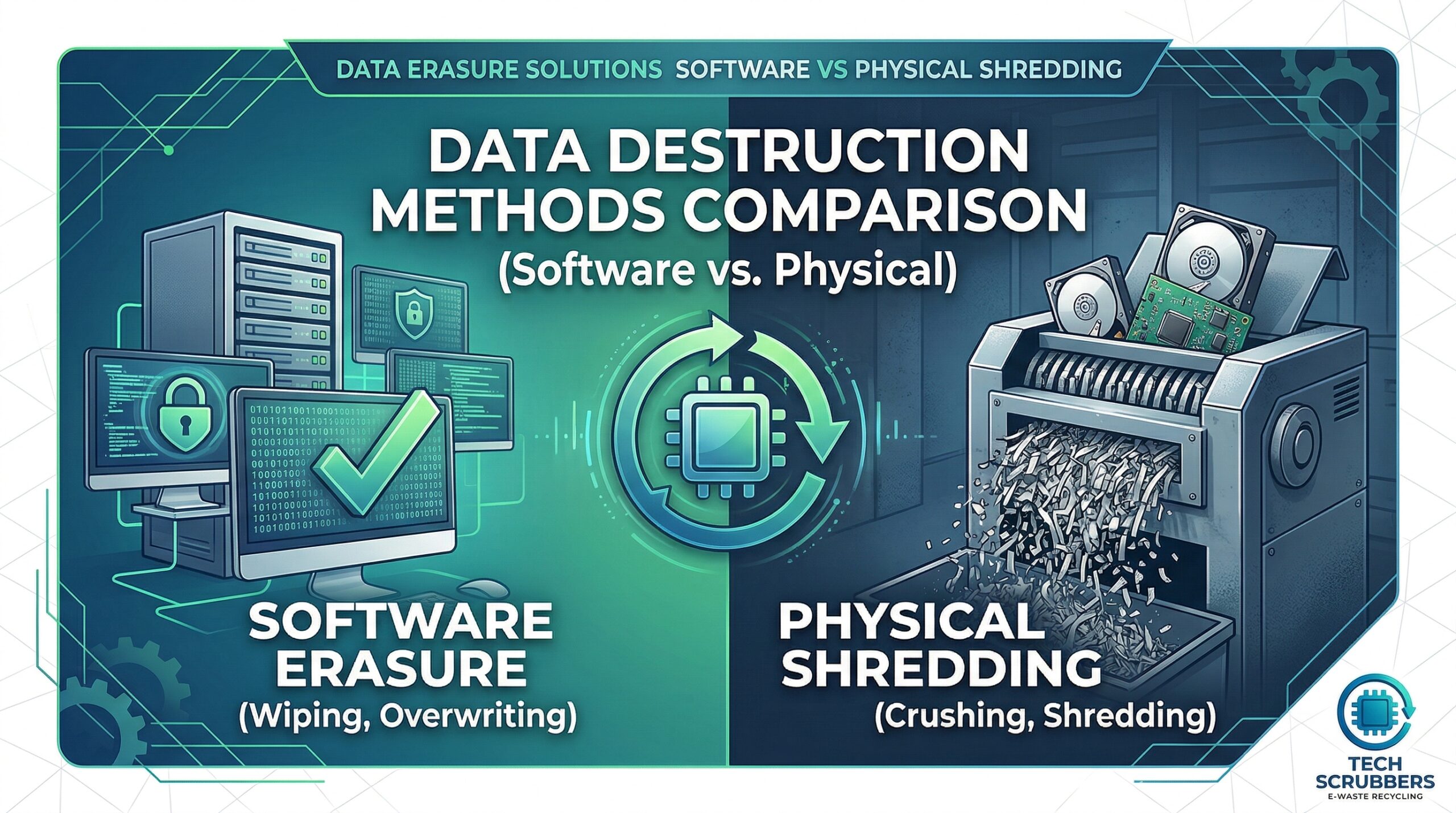
  • Data Destruction Methods Comparison (Software vs. Physical)

    Data Destruction Methods Comparison (Software vs. Physical)

    Data Erasure Solutions Software vs Physical Shredding

    Secure your business assets with industry-leading compliance and destruction methods.

    Get A Quote Today

    Choosing the Right Method for Your Business

    With data protection regulations becoming increasingly strict, permanently removing sensitive information from retired IT assets is a priority for every business. Whether you are upgrading your infrastructure or decommissioning old hardware, choosing between data erasure solutions software vs physical shredding affects your compliance, budget, and environmental impact.

    Understanding Data Destruction

    Data destruction renders information stored on electronic devices unrecoverable. Because the UK GDPR imposes heavy penalties for data breaches, businesses must ensure their end-of-life IT processes are secure, verifiable, and fully compliant.

    Software-Based Data Erasure

    Data erasure, or sanitisation, uses software to overwrite every sector of a storage device with random patterns, scrambling the original data until it cannot be recovered.

    The Advantages

    • Asset Reusability: Keep hardware intact for resale or internal redeployment.
    • Environmental Impact: Supports circular economy goals by reducing e-waste.
    • Verification: Receive a tamper-proof certificate of erasure for every device.
    Explore Erasure Services

    Physical Data Destruction

    Physical destruction involves mechanically or magnetically altering a storage device so it can never be read again, including industrial shredding and degaussing.

    When to Choose Physical Destruction

    • Maximum Security: Ideal for highly sensitive or classified data.
    • Damaged Assets: The only reliable method for faulty or non-functional drives.
    • Definitive Proof: Physical remains serve as tangible evidence of destruction.
    Learn About Shredding

    Comparison: Key Considerations

    Feature Software-Based Erasure Physical Shredding
    Asset Recovery High None
    Security Level High (Standard-compliant) Maximum (Irreversible)
    Environmental Impact Positive Negative

    Secure IT Asset Disposition with Techscrubbers

    At Techscrubbers, we provide certified data destruction services tailored to your security needs. Whether you require on-site shredding or software-based erasure, our team ensures full compliance with UK data protection standards.

    Why Choose Us Contact Our Team
  • What is WEEE? A Simple Explanation for UK Businesses

    What is WEEE? A Simple Explanation for UK Businesses

    WEEE Recycling UK: A Comprehensive Guide for Businesses

    Ensure your business stays compliant with UK environmental laws and data protection regulations. Discover professional, secure, and sustainable WEEE recycling solutions tailored for your organisation.

    Book Your Collection

    In today’s fast-paced digital world, managing electronic waste is not just an environmental concern but a critical operational requirement for any modern organisation. With over 1.4 million tonnes of Waste Electrical and Electronic Equipment (WEEE recycling UK) generated in the UK every year, businesses face the complex challenge of navigating stringent regulations to stay compliant and environmentally responsible. The rapid obsolescence of technology means that old IT equipment, from laptops to servers, quickly accumulates, posing significant risks if not handled correctly. At Techscrubbers.co.uk, we provide comprehensive WEEE recycling and IT asset disposal (ITAD) services, ensuring your business manages its electronic waste securely, legally, and sustainably.

    Understanding WEEE Regulations in the UK

    The WEEE Regulations are a cornerstone of UK environmental law, designed to reduce the environmental impact of electrical and electronic equipment throughout its lifecycle. Originating from the EU WEEE Directive (currently 2012/19/EU) and transposed into UK law, these regulations mandate the separate collection, treatment, and recovery of electronic waste. The primary goal is to prevent hazardous materials from entering landfills, promote reuse and recycling, and encourage producers to design more environmentally friendly products.

    Key Definitions You Need to Know

    • WEEE: Waste Electrical and Electronic Equipment. This broad category covers virtually any device that relies on electric currents or electromagnetic fields to function, from large household appliances and IT equipment to medical devices and lighting.
    • EEE: Electrical and Electronic Equipment. This refers to the products themselves before they become waste. Understanding what constitutes EEE helps businesses identify their responsibilities from procurement to disposal.
    • AATF: An Approved Authorised Treatment Facility. These are sites officially licensed by the Environment Agency to treat and recycle WEEE to specific environmental and safety standards. Using an AATF like Techscrubbers.co.uk is crucial for legal compliance.
    • Producer Responsibility: While primarily aimed at manufacturers and importers, businesses that generate WEEE also have a responsibility to ensure their waste is handled by approved schemes and facilities.

    WEEE Obligations and the “Duty of Care” for UK Businesses

    Under the Environmental Protection Act 1990, every business in the UK has a “Duty of Care” regarding its waste. This means you are legally responsible for ensuring that your electronic waste is handled, stored, transported, and disposed of by authorised parties. This responsibility extends from the moment the waste is generated until it reaches a final, legitimate disposal or recycling point. Failure to comply with WEEE regulations and your Duty of Care can lead to significant fines, prosecution, and severe damage to your company’s reputation and brand image.

    Key aspects of your Duty of Care include:

    • Proper Classification: Correctly identifying your waste as WEEE.
    • Secure Storage: Storing WEEE safely to prevent harm to people or the environment.
    • Using Licensed Carriers: Ensuring anyone who transports your WEEE is a registered waste carrier.
    • Waste Transfer Notes: Completing and retaining waste transfer notes for every collection, providing an auditable trail of your waste.
    • Authorised Facilities: Disposing of WEEE only at Approved Authorised Treatment Facilities (AATFs).

    Certified Data Security & Destruction

    In an era of stringent data protection laws like GDPR, simply deleting files is not enough. Our certified data destruction services ensure your sensitive information is permanently and irretrievably erased from all devices before recycling or reuse. We employ industry-leading techniques, including software wiping to government standards, degaussing, and physical shredding, providing you with a Certificate of Data Destruction for your audit trail and peace of mind.

    Learn about our security →

    Comprehensive IT Asset Disposal (ITAD)

    Beyond simple recycling, our ITAD services help you maximise the residual value of your old hardware. Through meticulous assessment, refurbishment, and responsible asset recovery processes, we extend the life of usable equipment, contributing to the circular economy. This not only offers potential financial returns but also significantly reduces your environmental footprint by diverting items from the waste stream and conserving valuable resources. We handle a wide range of assets, from laptops and desktops to servers, networking equipment, and mobile devices.

    View ITAD services →

    Why Choose Techscrubbers.co.uk?

    Partnering with the right WEEE recycling provider is crucial for compliance, data security, and environmental responsibility. Techscrubbers.co.uk stands out through:

    • Expertise & Experience: Years of experience in WEEE recycling and ITAD, with a team of trained professionals.
    • Full Compliance: We operate strictly within all UK WEEE regulations and environmental laws, providing all necessary documentation.
    • Certified Data Security: Adherence to the highest data destruction standards, including GDPR compliance and certified processes.
    • Environmental Commitment: A strong focus on reuse, refurbishment, and responsible recycling, aiming for zero-to-landfill.
    • Tailored Solutions: Customised collection and disposal plans to meet the unique needs of businesses of all sizes and sectors.
    • Transparent Reporting: Providing detailed audit trails, waste transfer notes, and certificates of destruction for complete accountability.

    WEEE Recycling in Manchester and Beyond

    For businesses located in Manchester and the surrounding areas, Techscrubbers.co.uk offers unparalleled local support for all your WEEE needs. Choosing a local partner like us provides numerous advantages: reduced transport costs, a lower carbon footprint for logistics, faster response times for collections, and a team that understands the specific logistical and regulatory landscape of the North West. Whether you operate a small office, a large corporate headquarters, an educational institution, or a healthcare facility, our Manchester-based team is ready to provide efficient, reliable, and compliant WEEE recycling and ITAD services. We offer flexible collection schedules, from one-off clearances to ongoing managed ITAD programs, ensuring your electronic waste is handled promptly and professionally.

    Get Started with Responsible WEEE Management

    Compliance with WEEE regulations is not merely a legal necessity; it’s a powerful opportunity to demonstrate your commitment to environmental responsibility and sound corporate governance. By partnering with Techscrubbers.co.uk, you gain a trusted ally who ensures your electronic waste is managed securely, legally, and sustainably. Protect your data, protect the environment, and enhance your brand’s reputation.

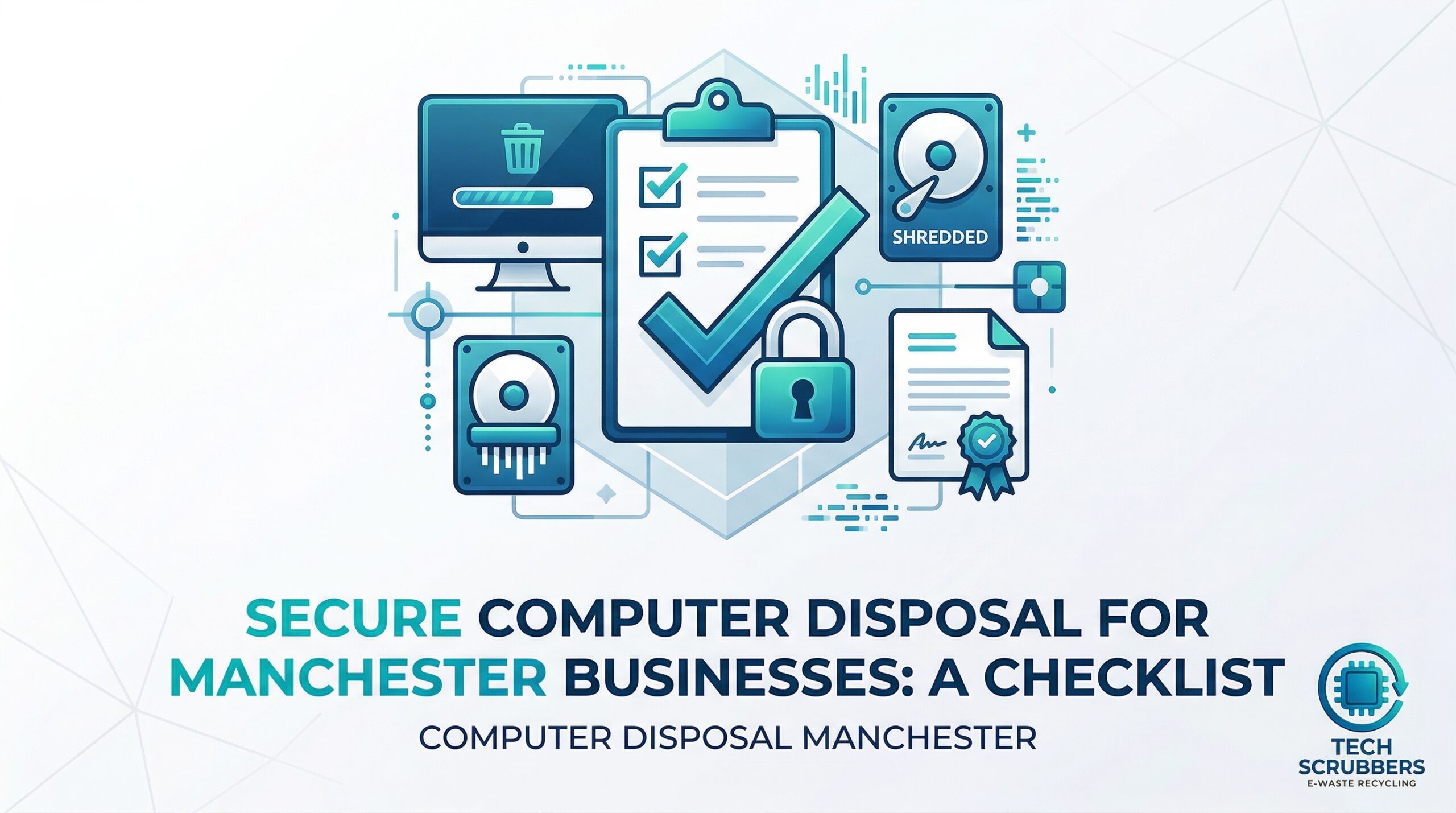
  • Secure Computer Disposal for Manchester Businesses: A Checklist

    Secure Computer Disposal for Manchester Businesses: A Checklist

    Secure Computer Disposal Manchester

    Protect your data and stay compliant with professional IT asset disposal services.

    Get A Free Consultation

    Secure Computer Disposal for Manchester Businesses: A Checklist

    For Manchester businesses, managing end-of-life IT equipment is more than a routine waste task; it is a legal and security necessity. Improperly discarded hardware can lead to data breaches, heavy regulatory fines, and environmental harm.

    This guide outlines the steps your organisation should take to manage computer disposal in Manchester, ensuring you stay compliant with UK law while keeping sensitive data secure.

    Why Secure Computer Disposal Matters

    Data Security

    A standard “delete” or “format” command does not permanently remove data. Ensure your sensitive information is irrecoverable with professional hard drive wiping.

    WEEE Compliance

    The WEEE Regulations dictate how businesses must handle electronic waste. You remain legally responsible for your equipment until it reaches a licensed facility.

    Environmental Responsibility

    Responsible recycling recovers valuable components and neutralises hazardous materials, helping Manchester meet its sustainability goals.

    Your Computer Disposal Checklist

    1. Inventory and Assessment: Categorise items by age, condition, and data sensitivity.
    2. Data Sanitisation Planning: Decide between software-based erasure or physical destruction.
    3. Data Erasure Execution: Use certified methods to process all storage media.
    4. Verification and Certification: Obtain a formal Certificate of Destruction for every device.
    5. Responsible Recycling: Ensure your partner holds valid waste carrier licences.
    6. Employee Training: Prevent data leaks by training staff on proper disposal procedures.
    7. Documentation: Keep a central record of all disposal activities for GDPR compliance.

    Choosing an ITAD Partner in Manchester

    When selecting a provider, look for ISO 27001 certifications, clear chain-of-custody procedures, and a proven track record of working with local Manchester-based businesses.

    TechScrubbers: Your Partner for Computer Disposal

    At TechScrubbers, we provide secure, compliant, and environmentally responsible IT asset disposal for businesses across Manchester. We use proven data destruction techniques and maintain a focus on sustainability.

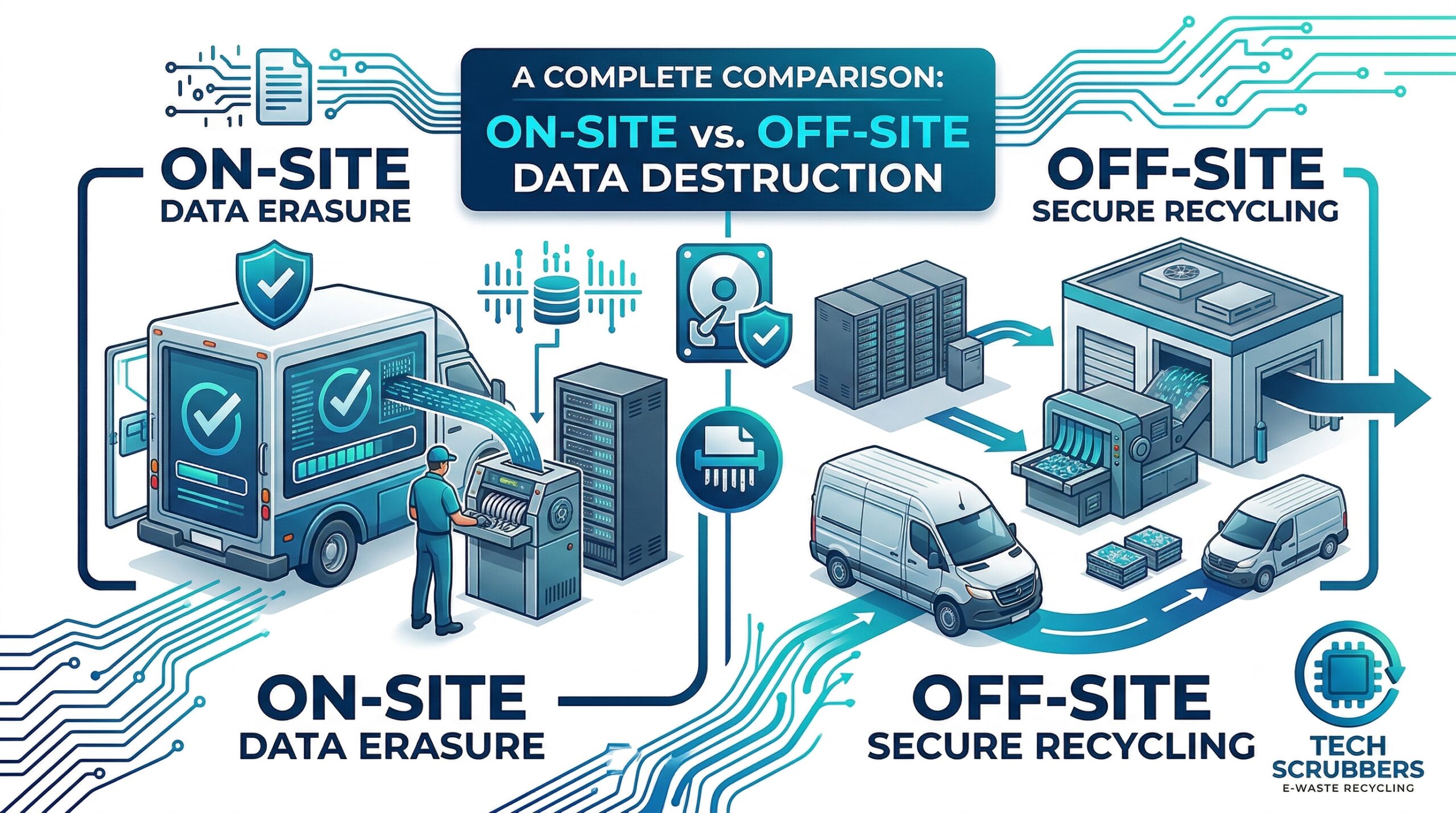
  • On-Site vs. Off-Site Data Destruction: A Complete Comparison

    On-Site vs. Off-Site Data Destruction: A Complete Comparison

    On-Site vs. Off-Site Data Destruction: A Guide for UK Businesses

    Ensure your organisation remains secure and compliant with professional on-site data erasure.

    Book Your On-Site Service

    With data privacy regulations becoming increasingly strict, secure IT asset disposal is no longer a back-office task; it is a core business requirement. Whether you are upgrading servers, replacing laptops, or decommissioning mobile devices, your chosen method for data sanitisation directly affects your risk profile. For many organisations, on-site data erasure has become the preferred method for maintaining total control over sensitive information.

    Why Data Destruction Matters

    Data destruction is the process of making information on storage devices unrecoverable. It is a fundamental part of IT Asset Disposition (ITAD). Under the UK General Data Protection Regulation (UK GDPR) and the Data Protection Act 2018, organisations are legally responsible for protecting personal data throughout its entire lifecycle, including the point of disposal.

    On-Site Data Destruction: Maintaining Control

    On-site destruction involves performing the sanitisation process at your own premises. This removes the risks associated with transporting sensitive hardware to a third-party facility.

    On-Site Data Erasure (Software-Based)

    On-site data erasure uses specialised software to overwrite every sector of a storage device with non-sensitive data. When done correctly, this makes the original information unrecoverable, even with forensic tools. Reputable providers follow international standards like NIST 800-88, ensuring the process is verifiable and audit-ready.

    On-Site Physical Destruction

    For faulty or redundant devices, physical destruction—such as industrial shredding, crushing, or degaussing—is the most definitive method. By shredding hard drives into fragments on-site, you ensure the media is destroyed before it leaves your sight.

    Off-Site Data Destruction: Outsourcing Security

    Off-site destruction involves a vendor collecting your IT assets and transporting them to a secure facility. While often marketed as a convenient solution, it introduces variables that businesses should carefully consider.

    On-Site vs. Off-Site: Comparison

    Feature On-Site Destruction Off-Site Destruction
    Security High: Data stays on-site. Moderate: Risk during transit.
    Chain of Custody Direct and transparent. Dependent on third-party logistics.

    Techscrubbers: Your Partner for On-Site Data Erasure

    At Techscrubbers, we specialise in secure, on-site data erasure for UK businesses. We know your data is a critical asset, and our goal is to ensure it remains protected until the moment it is erased. By bringing our certified processes directly to your facility, we provide the security and compliance that modern organisations need.

    View Our Certification Process Read Our Full Guide
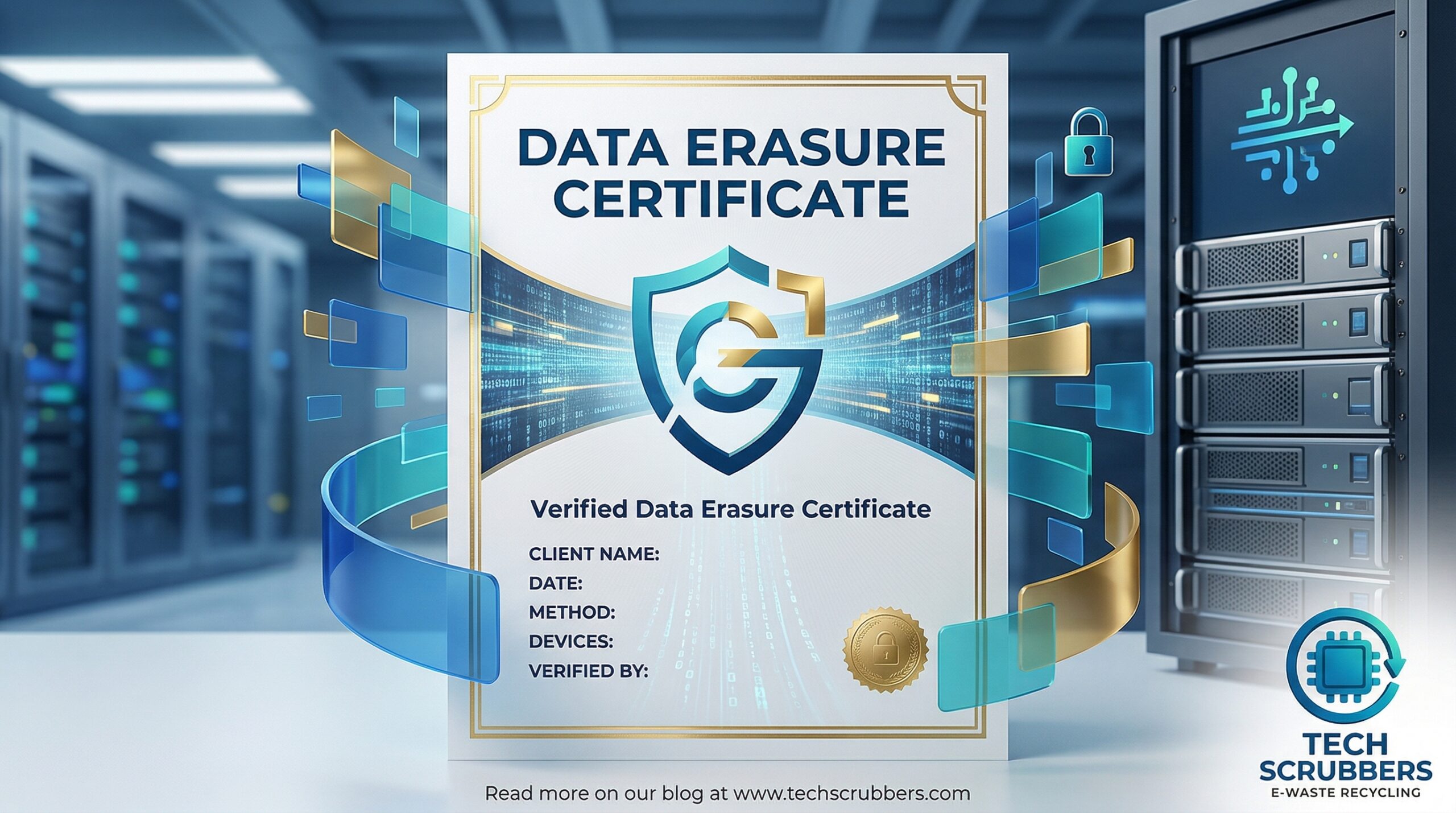
  • What is a Data Erasure Certificate and Why You Need One

    What is a Data Erasure Certificate and Why You Need One

    The Data Erasure Certificate: Your Essential Proof of Secure Data Disposal in the UK

    For any organisation handling sensitive information, securely disposing of IT assets is not just an administrative task—it’s a critical compliance requirement. This proof comes in the form of a data erasure certificate.

    Get Your Compliance Documentation

    When retiring, repurposing, or recycling hardware, you need solid proof that data is gone for good. This guide explains what a data erasure certificate involves, why it is necessary for meeting UK regulatory standards like GDPR, and how professional services ensure your data disposal process is fully auditable and compliant.

    Understanding Data Erasure Certificates

    A data erasure certificate is a formal, legally recognised document confirming that data has been permanently and securely removed from a storage device, making it unrecoverable by any means. It acts as the final, auditable record that a specific data sanitisation process was carried out according to recognised industry standards.

    What is a Data Erasure Certificate?

    This certificate goes beyond simple deletion. It confirms that the storage media underwent a thorough sanitisation process designed to eliminate all residual data traces (data remanence). For businesses disposing of IT equipment, migrating systems, or decommissioning servers, this document is key to demonstrating due diligence.

    What Information is Included in a Data Erasure Certificate?

    A good certificate provides a clear, traceable audit trail. Key details usually include:

    • Service Provider Details: The name and contact information of the company that performed the erasure (e.g., TechScrubbers.co.uk).
    • Client Identification: The name and contact details of the organisation whose data was erased.
    • Device Identification: Unique identifiers for every piece of hardware processed, such as serial numbers, model numbers, and asset tags.
    • Data Erasure Method: Specification of the exact software or technique used (e.g., Blancco, or a specific overwrite pattern).
    • Verification Confirmation: A statement confirming the successful completion and verification of the erasure process.
    • Date of Erasure: The precise date the sanitisation was performed.
    • Standard Adherence: Reference to the specific data sanitisation standard followed (e.g., NIST 800-88).
    • Authorisation: A signature or digital stamp from an authorised representative of the erasure provider.

    Why is a Data Erasure Certificate Important?

    The value of this document covers security, finance, and reputation:

    1. Auditability and Compliance: It provides clear evidence to regulators, auditors, or clients that you have met your legal obligations regarding data protection.
    2. Legal Protection: If a future data breach is traced back to improperly disposed hardware, the certificate shows you exercised due diligence in data removal.
    3. Assurance: It offers certainty that sensitive corporate, financial, or personal data cannot be recovered from retired assets.

    Data Erasure Standards and Methods

    The credibility of your certificate depends entirely on the standard used to perform the erasure. Simply deleting files or reformatting a drive leaves recoverable data remnants.

    Understanding Data Sanitisation Standards

    Reputable data erasure services follow internationally recognised benchmarks. Key standards referenced on a professional certificate include:

    • NIST SP 800-88 Revision 1: Guidelines for Media Sanitisation, published by the US National Institute of Standards and Technology. This is a globally respected framework defining clear sanitisation levels.
    • HMG IS5: The standard defined by the UK Government for data sanitisation, often required for public sector contracts.
    • ADISA (Asset Disposal & Information Security Alliance): ADISA certification is a recognised benchmark for data sanitisation providers, focusing heavily on process integrity and auditability within the IT Asset Disposition (ITAD) sector.
    • ISO 27001: While this covers Information Security Management Systems, adherence to it implies a strong framework for managing data security risks, including disposal.

    Common Data Erasure Methods

    Data sanitisation involves several techniques, each suited for different media:

    • Software-Based Data Erasure: Overwriting the storage media multiple times with specific binary patterns. This is the standard method for modern HDDs and SSDs when the device is to be reused or recycled.
    • Degaussing: Applying an extremely powerful magnetic field to make magnetic media (like traditional HDDs) completely unusable and the data unrecoverable. This method does not work on solid-state drives (SSDs).
    • Physical Destruction: Shredding, crushing, or incinerating the storage device. This is the most secure method but prevents reuse and is less environmentally friendly.

    The choice depends on the storage media. For example, modern SSDs require specific software commands (like Secure Erase or TRIM) to ensure all memory blocks are cleared, a process that differs significantly from erasing a traditional Hard Disk Drive (HDD).

    DIY Data Erasure vs. Professional Data Erasure Services

    Many businesses try to handle data erasure internally, but this often introduces significant, hard-to-measure risks.

    The Risks of DIY Data Erasure

    Attempting to erase data without professional tools or expertise carries serious consequences:

    • Incomplete Erasure: Standard deletion or formatting leaves data easily recoverable using common forensic tools.
    • Lack of Verification: Without certified software, you cannot definitively prove the erasure was successful across all sectors of the drive.
    • Compliance Failure: Auditors will not accept internal, undocumented processes as proof of GDPR compliance.
    • Reputational Damage: A data leak resulting from poor disposal practices can severely harm client trust.

    The Benefits of Professional Data Erasure Services

    Partnering with a certified provider like TechScrubbers.co.uk reduces these risks by offering:

    • Guaranteed Expertise: Use of industry-leading, certified erasure software that meets strict standards.
    • Full Verification and Audit Trails: Every erasure is logged, verified, and documented.
    • Regulatory Assurance: Confidence that the process meets the requirements of the Data Protection Act 2018 and GDPR.
    • The Data Erasure Certificate: The final, legally sound document confirming compliance.

    Checklist for Choosing a Data Erasure Service

    When evaluating providers, confirm they can verify the following:

    Criterion Check
    Certifications Are they certified by recognised bodies (e.g., ADISA)?
    Standards Adherence Do they guarantee erasure to NIST 800-88 or HMG IS5?
    Verification Do they provide verifiable, auditable reports for every device?
    Media Expertise Can they securely erase HDDs, SSDs, and mobile devices?
    Documentation Is a comprehensive Data Erasure Certificate guaranteed?

    Data Erasure for Different Types of Devices

    Data security protocols must adapt to the underlying technology of the storage medium.

    Hard Drives (HDDs)

    Traditional HDDs are effectively erased using multi-pass overwriting methods or degaussing (if the drive is not being reused).

    Solid-State Drives (SSDs)

    SSDs present unique challenges due to wear-levelling and over-provisioning. Simple overwriting is often not enough. Secure erasure requires using the drive’s internal firmware commands (like Secure Erase or TRIM) to ensure all NAND cells are cleared.

    USB Drives and Mobile Devices

    These smaller media require specialised tools capable of interfacing with their unique controllers. Secure erasure on smartphones often involves cryptographic erasure if the device supports hardware encryption, or a full factory reset verified against industry standards.

    The Data Erasure Process with TechScrubbers.co.uk

    TechScrubbers.co.uk provides end-to-end data security, ensuring compliance and environmental responsibility, particularly for businesses across Manchester and the wider UK.

    Our Data Erasure Process

    Our process is straightforward and designed for maximum security:

    1. Asset Collection & Logging: Devices are securely collected, and all serial numbers are logged against the client’s asset register.
    2. Data Erasure Execution: We use industry-leading, certified software to perform the erasure process, tailored to the specific media type (HDD, SSD, etc.).
    3. Verification and Reporting: Each device undergoes a verification scan to confirm the erasure was successful. A detailed log is generated.
    4. Certificate Issuance: Upon successful verification, we issue the formal data erasure certificate for your records.
    5. Responsible Disposition: Devices that cannot be reused are recycled in line with WEEE regulations, promoting sustainability.

    The Data Erasure Certificate You’ll Receive

    The certificate issued by TechScrubbers.co.uk is your definitive proof of compliance. It clearly links the serial number of the retired asset to the successful execution of a recognised sanitisation standard, providing the necessary documentation for any regulatory review.

    Benefits of Choosing TechScrubbers.co.uk

    As a UK-based specialist, we offer:

    • Local Expertise: Deep understanding of UK data protection laws and regulatory expectations.
    • Certified Methods: Commitment to using audited, verifiable erasure techniques.
    • Full Traceability: Complete chain of custody documentation from collection to certification.

    Frequently Asked Questions (FAQs)

    What is the difference between data erasure and data destruction?

    Data erasure securely removes data so the device can be reused or recycled responsibly. Data destruction physically destroys the device, making reuse impossible but guaranteeing data loss.

    Is formatting a hard drive enough to erase data?

    No. Formatting only removes the file system pointers, leaving the underlying data intact and easily recoverable.

    How long does data erasure take?

    This depends on the volume of data and the method used. Software erasure on modern drives can take several hours per device, while physical destruction is instantaneous.

    What happens to the devices after data erasure?

    After certification, devices are either securely wiped and remarketed (if viable) or responsibly recycled via our WEEE-compliant channels.

    In the current regulatory climate, relying on guesswork for data disposal is a liability. The data erasure certificate is not optional; it is a fundamental requirement for showing accountability under GDPR and the Data Protection Act 2018.

    Ensure Your Compliance Today
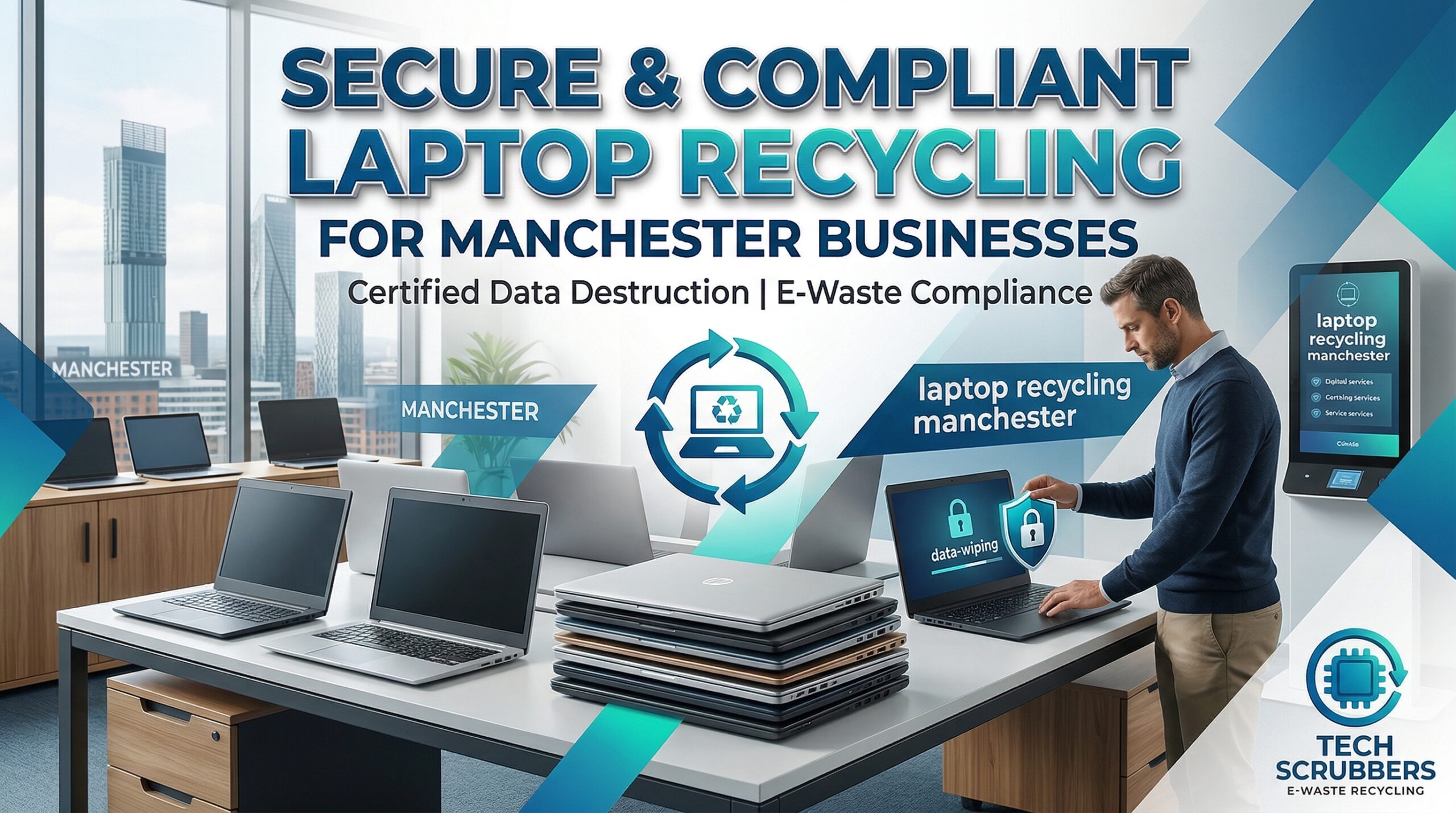
  • Secure & Compliant Laptop Recycling for Manchester Businesses

    Secure & Compliant Laptop Recycling for Manchester Businesses

    Secure & Compliant Laptop Recycling for Manchester Businesses

    Protect your data and the environment with professional, certified IT disposal services.

    Get Your Free Quote

    For businesses across the North West, managing the end-of-life cycle for IT hardware is a significant operational challenge. Professional laptop recycling in Manchester is more than just clearing out office space; it is a necessary step for data security, legal compliance, and environmental responsibility. As your organisation upgrades its technology, ensuring that redundant devices are handled securely is essential to protecting sensitive information and meeting regulatory obligations.

    Why Laptop Recycling Matters for Manchester Businesses

    Improper disposal of IT equipment poses real risks to both the environment and your company’s reputation. Understanding these risks is the first step toward building a reliable IT asset disposition strategy.

    Environmental Responsibility

    Laptops contain hazardous materials like lead and mercury. Recycling these devices ensures that toxic materials are handled safely and valuable raw materials are recovered, supporting a circular economy.

    Data Security & GDPR Compliance

    A laptop is a gateway to your business data. Simply deleting files is not enough. Under GDPR, businesses are legally responsible for the data they hold until it is permanently destroyed. Learn more about our data erasure services.

    Our Secure Laptop Recycling Process

    1. Secure Collection

    We provide secure, tracked collection services across Manchester, ensuring hardware is handled with strict security.

    2. Data Sanitisation

    We offer certified data erasure and physical destruction to ensure your data is unrecoverable.

    3. Certification

    We issue a formal Certificate of Destruction for every device, providing your audit trail.

    Frequently Asked Questions

    How do I know my data is truly gone?
    We provide a Certificate of Destruction for every device, following NIST 800-88 standards.

    Can you handle bulk collections?
    Yes, we are equipped to manage large-scale IT refreshes for businesses across Greater Manchester. View our office clearance services.

    Ready to get started?

    Contact Techscrubbers today for a free consultation or to request a quote for your laptop recycling needs.

    Contact Us Today
  • A Guide to Data Erasure Standards: NIST 800-88 and DoD 5220.22-M Fully Explained

    A Guide to Data Erasure Standards: NIST 800-88 and DoD 5220.22-M Fully Explained

    A Guide to Data Erasure Standards: NIST 800-88 and DoD 5220.22-M Explained

    Data erasure is the essential process of permanently removing data from a storage device, making it completely unrecoverable. In an age defined by strict data privacy laws and rising cyber threats, securely destroying sensitive information before device disposal, resale, or repurposing is mandatory. True data erasure standards require strict methods, usually involving multiple overwrites or physical destruction, to scramble the original information beyond recovery. For UK businesses managing compliance, understanding these established protocols is necessary for cutting risk and keeping trust.

    Understanding Data Erasure: Why It Matters

    The need for strong data sanitisation goes beyond simple security upkeep; it is a core requirement for legal compliance and protecting your brand.

    The Growing Threat of Data Breaches

    Data breaches continue to affect organisations across all sectors. When sensitive assets—like customer records, intellectual property, or financial data—are compromised due to poor disposal, the consequences can be severe.

    Compliance with Data Privacy Regulations (GDPR)

    The General Data Protection Regulation (GDPR) requires organisations to use appropriate security measures to protect personal data, which clearly includes secure data disposal. Failing to meet these requirements can lead to significant financial penalties.

    Protecting Your Reputation and Brand Image

    A data leak caused by retiring devices insecurely can instantly damage customer trust and cause lasting harm to an organisation’s reputation. Taking proactive, verifiable steps toward data erasure shows a real commitment to security.

    Legal and Ethical Considerations

    Organisations have both a legal duty and an ethical obligation to protect the data entrusted to them. Following recognised standards proves that due diligence was performed when retiring assets.

    Key Data Erasure Terminology

    Data sanitisation is a wide term covering several techniques, each suitable for different security needs.

    Data Sanitisation
    This general term includes all methods used to make data inaccessible, grouped by the required security level.
    Clearing
    This involves overwriting data with non-sensitive information, like zeros. It works for data that doesn’t need the highest security clearance.
    Purging
    Purging aims to make data unrecoverable even using advanced lab techniques. This usually means multiple, patterned overwrites or cryptographic erasure.
    Destruction
    This is the most final method, involving physically destroying the storage device itself (e.g., shredding or crushing), ensuring the data cannot be recovered at all.
    Overwriting
    The process of replacing existing data on a storage medium with new data, often using random characters or a fixed pattern.
    Degaussing
    Using a powerful magnetic field to scramble the magnetic domains on traditional hard drives (HDDs) and tapes, effectively erasing the stored data. This method does not work on solid-state drives (SSDs).
    Cryptographic Erasure
    This method involves securely destroying the encryption key used to protect the data. If the key is gone, the encrypted data becomes permanently unreadable.

    NIST 800-88: Guidelines for Media Sanitization

    Developed by the National Institute of Standards and Technology (NIST), NIST 800-88 Revision 1 is the widely accepted benchmark for sanitising data across various media types, including HDDs, SSDs, tapes, and mobile devices. It offers a clear structure based on data sensitivity and the risk of recovery.

    NIST 800-88 Sanitisation Levels

    NIST defines three main levels of sanitisation:

    Clear

    This level is suitable for data that is not considered highly sensitive.

    • Recommended Methods: A single-pass overwrite using zeros or random characters is often enough for media that will stay within the organisation’s control.

    Purge

    This level is necessary for data that requires a higher security posture.

    • Recommended Methods: This involves multiple overwrites using different patterns, degaussing (for magnetic media only), or cryptographic erasure.

    Destroy

    This level is required for media holding highly sensitive data or when the storage device is otherwise unusable.

    • Recommended Methods: Physical destruction, such as shredding, crushing, or incineration, ensuring the media platters or chips are rendered inoperable.

    Applying NIST 800-88 to Different Storage Media

    NIST 800-88 recognises that modern storage setups need tailored approaches. For example, standard overwriting methods often fail for SSDs because wear-levelling algorithms spread data across many physical blocks, making a single overwrite pattern unreliable.

    DoD 5220.22-M: The Department of Defense Standard

    The DoD 5220.22-M standard, which was historically part of the National Industrial Security Program Operating Manual (NISPOM), set out procedures for sanitising storage media used by US government contractors.

    The DoD 5220.22-M Overwriting Process

    This standard is best known for its requirement of multiple overwrite passes, often described as a 7-pass process. This usually involved writing a specific pattern, its opposite, and then a random pattern, repeated seven times, followed by a final verification pass.

    Limitations of DoD 5220.22-M

    While historically important, the DoD standard is increasingly seen as outdated, especially concerning modern storage technologies. Its reliance on sequential overwriting does not account for the complex internal mapping used by SSDs, making it less reliable for solid-state media than NIST guidelines. In many current situations, NIST 800-88 has replaced DoD 5220.22-M as the preferred best practice.

    NIST 800-88 vs. DoD 5220.22-M: A Detailed Comparison

    Knowing the differences between these two major standards is key to choosing the right disposal strategy.

    Key Similarities

    Both standards aim to stop data recovery through software by requiring data overwriting as a main sanitisation technique. Both also require some form of verification to confirm the process succeeded.

    Key Differences

    Feature NIST 800-88 (Rev. 1) DoD 5220.22-M
    Scope Broad guidelines for all media types (HDD, SSD, Tape, Mobile). Primarily focused on magnetic media (HDDs/Tapes).
    Methodology Groups methods into Clear, Purge, Destroy based on risk. Specifies exact, multi-pass overwrite sequences (e.g., 7-pass).
    SSD Suitability Directly addresses SSD issues, recommending Secure Erase or Cryptographic Erase for purging. Ineffective for SSDs due to wear-levelling issues.
    Current Relevance Considered the current global best practice. Mostly historical; often referenced but superseded by NIST for modern compliance.

    Which Standard Should You Choose?

    For most commercial and regulatory compliance needs in the UK, NIST 800-88 offers the most current, flexible, and technically sound framework. It lets organisations match their erasure method exactly to the sensitivity of the data being destroyed, rather than sticking to a rigid, potentially ineffective, multi-pass routine.

    Choosing the Right Data Erasure Method

    Picking the right method depends on several important factors related to the hardware and the data it contained.

    Factors to Consider

    When deciding on the best approach, evaluate:

    1. Data Sensitivity: Was the data highly confidential (requiring Purge/Destroy) or general business information (suitable for Clear)?
    2. Storage Media Type: HDDs handle degaussing and overwriting well; SSDs need specific commands like Secure Erase or physical destruction.
    3. Regulatory Requirements: Does your industry require adherence to a specific standard (e.g., financial services or healthcare)?
    4. Budget and Time: Physical destruction is fast but expensive; software erasure is cheaper but takes longer.

    Data Erasure Software

    Modern erasure software tools are built to automate the NIST-compliant process, often incorporating device-specific commands (like ATA Secure Erase for SSDs) and providing detailed audit reports.

    Data Erasure as a Service (DEaaS)

    Hiring specialised providers like TechScrubbers for data erasure offers major benefits. Professionals bring experience in handling different media, guarantee adherence to the latest standards, and supply verifiable certificates, taking the compliance management load off your internal IT staff.

    DIY vs. Professional Data Erasure

    While in-house erasure is possible, using professional services reduces the chance of human error, ensures the correct tools are used for every media type, and provides the necessary documentation required for audits.

    Data Erasure Verification and Certification

    The process isn’t finished until success is proven. Unverified erasure leaves an organisation open to liability.

    The Importance of Verification

    Verification confirms that the sanitisation process successfully overwrote or destroyed the targeted data sectors. Without verification, the erasure process is just guesswork.

    Data Erasure Certification

    A formal Certificate of Erasure creates a permanent audit trail. This document lists the media serial numbers, the standard applied (e.g., NIST 800-88 Purge), the date, and the technician in charge. This is vital evidence during regulatory audits.

    TechScrubbers’ Data Erasure Process and Certification

    At TechScrubbers, we strictly follow NIST 800-88 guidelines. Our process includes pre-scanning, applying the required sanitisation method (software or physical), post-verification scanning, and issuing a complete Certificate of Erasure for every asset processed, ensuring full compliance for our clients.

    Data Erasure and GDPR Compliance in the UK

    For companies operating under UK GDPR, secure data disposal is a direct compliance duty.

    GDPR Requirements for Data Disposal

    GDPR demands that personal data, once it is no longer needed for the original purpose, must be securely deleted or anonymised. This rule applies equally to data stored on retired hardware.

    The “Right to be Forgotten”

    Data erasure is the practical way organisations meet requests under the “Right to be Forgotten” (Article 17 of GDPR), ensuring personal data is permanently removed from all accessible storage.

    Data Erasure as a Key Component of GDPR Compliance

    Putting in place a documented, standards-based erasure policy is a fundamental part of any strong GDPR compliance strategy, showing accountability and appropriate technical safeguards.

    TechScrubbers: Your Trusted Data Erasure Partner in the UK

    TechScrubbers offers expert, compliant data sanitisation services tailored specifically for the regulatory environment of the United Kingdom.

    Our Data Erasure Services

    We provide complete data security solutions, specialising in applying NIST 800-88 standards across diverse IT estates, from single workstations to large data centre decommissioning projects. Learn more about our certified data erasure services.

    Our Data Erasure Process

    Our method ensures maximum security: we identify, catalogue, apply the correct NIST-level sanitisation (Clear, Purge, or Destroy), verify the results using top industry tools, and provide full documentation. We are skilled at handling the challenges of modern media, including SSDs and virtual environments.

    Our Certifications and Compliance

    We maintain strict internal standards that match UK data protection needs, ensuring every erasure project can be audited and fully complies with data protection legislation.

    Serving Businesses in Manchester and Across the UK

    Though based locally, TechScrubbers supports businesses throughout the UK, delivering reliable, secure, and certified data erasure solutions wherever your assets are located. Explore our secure on-site options.

    Contact TechScrubbers today for a free consultation on achieving NIST 800-88 compliant data erasure for your organisation.

    Request A Compliance Quote