
Category: Hard Drive Wiping

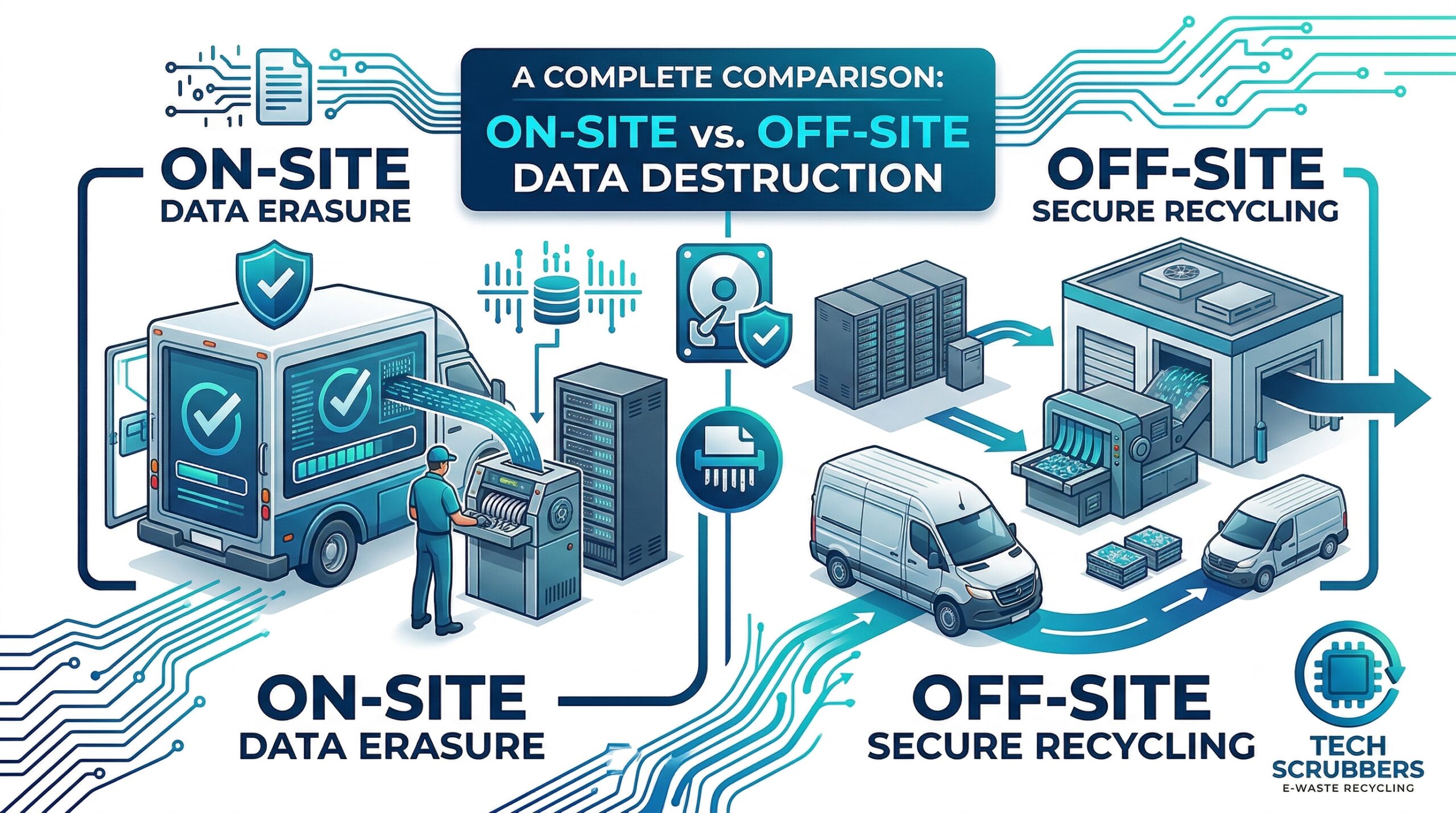
  • On-Site vs. Off-Site Data Destruction: A Complete Comparison

    On-Site vs. Off-Site Data Destruction: A Complete Comparison

    On-Site vs. Off-Site Data Destruction: A Guide for UK Businesses

    Ensure your organisation remains secure and compliant with professional on-site data erasure.

    Book Your On-Site Service

    With data privacy regulations becoming increasingly strict, secure IT asset disposal is no longer a back-office task; it is a core business requirement. Whether you are upgrading servers, replacing laptops, or decommissioning mobile devices, your chosen method for data sanitisation directly affects your risk profile. For many organisations, on-site data erasure has become the preferred method for maintaining total control over sensitive information.

    Why Data Destruction Matters

    Data destruction is the process of making information on storage devices unrecoverable. It is a fundamental part of IT Asset Disposition (ITAD). Under the UK General Data Protection Regulation (UK GDPR) and the Data Protection Act 2018, organisations are legally responsible for protecting personal data throughout its entire lifecycle, including the point of disposal.

    On-Site Data Destruction: Maintaining Control

    On-site destruction involves performing the sanitisation process at your own premises. This removes the risks associated with transporting sensitive hardware to a third-party facility.

    On-Site Data Erasure (Software-Based)

    On-site data erasure uses specialised software to overwrite every sector of a storage device with non-sensitive data. When done correctly, this makes the original information unrecoverable, even with forensic tools. Reputable providers follow international standards like NIST 800-88, ensuring the process is verifiable and audit-ready.

    On-Site Physical Destruction

    For faulty or redundant devices, physical destruction—such as industrial shredding, crushing, or degaussing—is the most definitive method. By shredding hard drives into fragments on-site, you ensure the media is destroyed before it leaves your sight.

    Off-Site Data Destruction: Outsourcing Security

    Off-site destruction involves a vendor collecting your IT assets and transporting them to a secure facility. While often marketed as a convenient solution, it introduces variables that businesses should carefully consider.

    On-Site vs. Off-Site: Comparison

    Feature On-Site Destruction Off-Site Destruction
    Security High: Data stays on-site. Moderate: Risk during transit.
    Chain of Custody Direct and transparent. Dependent on third-party logistics.

    Techscrubbers: Your Partner for On-Site Data Erasure

    At Techscrubbers, we specialise in secure, on-site data erasure for UK businesses. We know your data is a critical asset, and our goal is to ensure it remains protected until the moment it is erased. By bringing our certified processes directly to your facility, we provide the security and compliance that modern organisations need.

    View Our Certification Process Read Our Full Guide
  • The Spy in the Corner – Printer Hard Drive Wiping

    The Spy in the Corner – Printer Hard Drive Wiping

    Cyber Security Alert

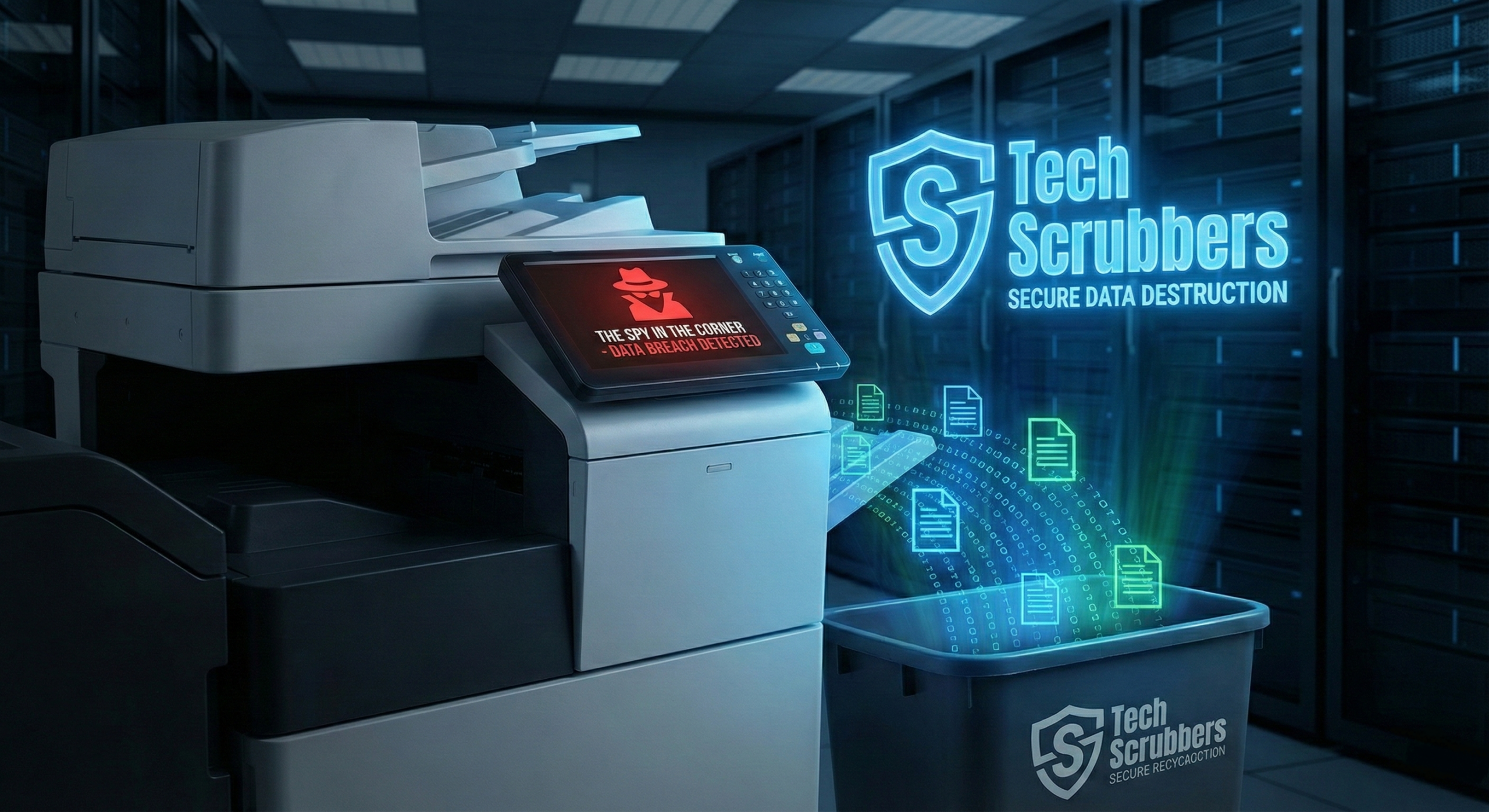
    The Spy in the Corner: Why Your Office Printer is Your Biggest Data Leak

    It remembers every scan, every invoice, and every passport. And you probably just sold it on eBay.

    Picture this: You’ve just completed a major office upgrade in Manchester. The old laptops have been professionally wiped by a certified team. The servers have been physically destroyed. You are 100% GDPR compliant.

    Or so you think.

    While you were focusing on the computers, the large multifunction printer (MFP) in the hallway was loaded onto a van and sold to a second-hand dealer. Nobody touched it. It’s just a printer, right?

    Wrong. That printer contains a hard drive. And on that hard drive is a digital image of every single document you have scanned, copied, or printed in the last three years.

    The Anatomy of a Hidden Breach

    Modern office equipment isn’t just mechanical; it is a sophisticated computer with a paper tray. These devices use Non-Volatile Random Access Memory (NVRAM) and internal HDDs to store job logs, address books, and cached document images.

    This isn’t paranoia; it is a documented security flaw. When these devices lose power, the data does not vanish. It sits there, waiting for the next owner to hit “Print Log”.

    > CONNECTING TO DEVICE: CANON-IR-ADVANCE-C5535
    > ACCESS LEVEL: ADMIN (DEFAULT PASSWORD)
    > MOUNTING HDD VOLUME… SUCCESS.
    > SCANNING SECTOR 001-999…

    [!] 4,203 FILES FOUND.
    > FILE TYPE: .PDF (OCR)
    > CONTENT SAMPLE:
      – “Payroll_Aug_2025.pdf”
      – “CEO_Passport_Scan_Color.jpg”
      – “Confidential_Merger_Draft_v2.docx”

    > STATUS: FULLY RECOVERABLE

    If you don’t specifically target these devices for Certified Data Erasure, you are essentially handing your most sensitive intellectual property directly to the highest bidder.

    The “Hidden 4” Devices You Forgot to Wipe

    It’s not just printers. Your office is full of “Smart” devices (IoT) that hoard data. At Tech Scrubbers, we include these in our standard “Hidden Asset” audit—something most basic recycling firms ignore.

    🖨️

    Multifunction Printers

    The Threat: Internal HDDs store copies of scans and prints.

    The Data: Invoices, HR records, contracts, and network Wi-Fi passwords.

    📞

    VoIP Phones

    The Threat: On-board storage for call logs and contacts.

    The Data: Client phone numbers, recorded voicemails, and call metadata.

    📺

    Smart TVs & Boards

    The Threat: Cached login tokens and session data.

    The Data: Presentation slides, browser history, and saved passwords for streaming apps.

    🛰️

    Network Switches

    The Threat: Configuration files stored in flash memory.

    The Data: Network topology maps and encryption keys that hackers love.

    How to Fix It (The Tech Scrubbers Way)

    Factory resetting a printer usually only clears the user settings, not the hard drive data. To be safe, you need a forensic approach. Here is how we handle “Hidden Data” during an Office IT Clearance:

    • Identify: We create an asset register that includes ALL powered devices, not just computers.
    • Isolate: We disconnect devices from the network before decommissioning to prevent last-minute cloud syncs.
    • Purge: We use specialist software (like Blancco) designed for printer sanitisation, or physically remove and shred the drive.
    • Verify: Your Certificate of Destruction will explicitly list the printer’s serial number, proving compliance to auditors.

    Don’t Let Your Printer Talk.

    Get a free “Hidden Asset” Audit included with your next collection in Manchester. Secure your data from the corner office to the copy room.

    Book Your Audit